

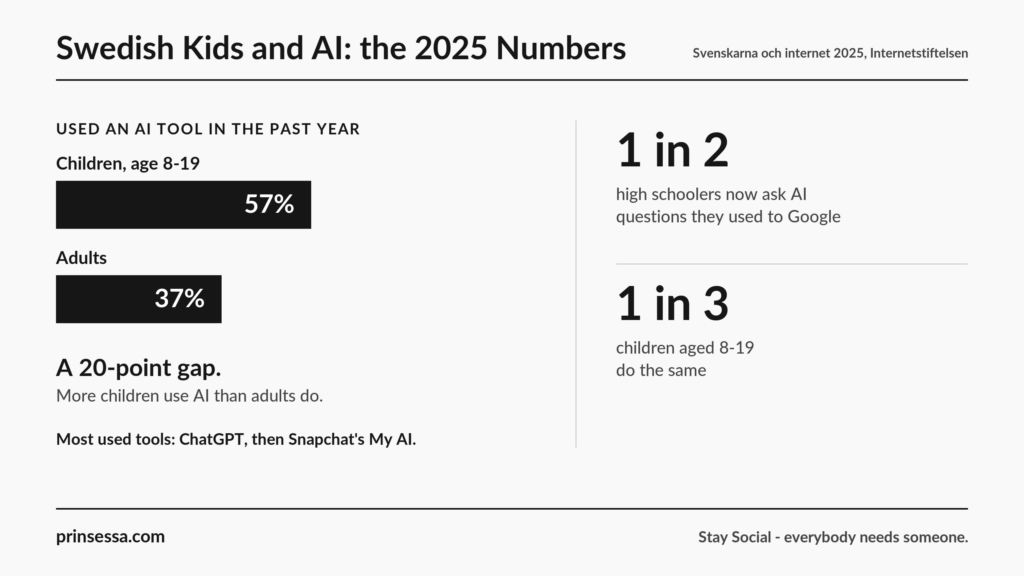
More Swedish children use AI tools than Swedish adults do. The gap is wide. 57 percent of children aged 8 to 19 used an AI tool in the past year, compared to 37 percent of adults. Twenty percentage points. That’s not a marginal difference. That’s a generational shift in how an entire age group looks for answers, company, and conversation.
The numbers come from Svenskarna och internet 2025, an annual report from Internetstiftelsen, the Swedish foundation that oversees the .se domain and tracks how the country uses the internet. The supplement on children and AI was published in November 2025. It contains more than headline figures. It says something about how this generation is now living.
What the Report Actually Shows
ChatGPT is the tool most Swedish children use. My AI comes second – Snapchat’s built-in chatbot, which sits inside one of the social spaces where children already talk to their friends. Use is highest in middle school and high school. Half of high schoolers now ask AI questions they would previously have googled. One in three children across the full 8–19 range does the same.
Girls are catching up to boys this year in ChatGPT use. That matters. The gender gap visible in the 2023 numbers is closing.
But it’s another finding in the report that lands hardest. When Internetstiftelsen asked the youngest children – those in primary school – what they value most about AI in their spare time, the answer wasn’t practical. It was relational.
They like using AI tools as a friend they can joke and play with. At night, when their friends are asleep, they talk to the AI tool instead.
That’s the report’s own wording. It deserves to be read slowly. What the children are describing is not a search tool. It’s company. And not just any company – company that’s still awake after their human friends have gone to bed.
What Bris Hears in Its Calls
Bris, Sweden’s main children’s rights organization, has noticed the same thing from a completely different angle. Bris runs national support lines that take thousands of calls and chats from children every year. On its page about children’s digital lives, it writes something unusually direct for a children’s rights organization:
In conversations with Bris, children and young people describe AI services as easily accessible and safe, almost like a friend. Some describe how strong feelings can be awakened, and that a kind of loving relationship can emerge.
Easily accessible. Safe. Almost like a friend. A loving relationship. These are not words that appear by accident in a Bris text. They are observations gathered from children who are experiencing exactly this, and who needed somewhere to talk about it.
Then comes the harder line:
As more and more people turn to automated solutions for emotional needs, there is a risk that human contact, with its unique capacity for empathy, understanding, and real presence, gets pushed aside.
Bris gives a concrete example. A conversation with an AI about feeling uncomfortable in one’s body can, gradually and without a clear turning point, drift in a destructive direction. Toward thinness-promoting content. The advice tightens in a direction no adult chose. That’s not a hypothesis. It’s something Bris sees happening.
Where the Discussion Usually Lands, and What It Misses
When numbers like these get published, the conversation almost always settles in the same places. Screen time. Parental controls. Platform regulation. Demands on the developers. None of these is the wrong starting point. Folkhälsomyndigheten’s 2024 screen time guidelines have a function. The EU AI Act is being phased in and will tighten the regulatory field over the coming year. Mediemyndigheten has been tasked with mapping how social media algorithms steer content toward children aged 9 to 18.
But something fundamental about the children’s actual behavior tends to get missed in the technical and political conversations.
The child holding the phone at 1:30 in the morning isn’t doing it because the technology is available. She’s doing it because she needs someone to talk to at that hour. At that hour, no one else is there. ChatGPT answers. My AI answers. The only adult-like contact that’s awake isn’t actually an adult.
The technology isn’t the cause of the need. The technology is the place where the need gets met, because the other places are closed.
That’s where the conversation needs to start, not end.
Who’s Responsible for the Answer
If children are already turning to AI for company, and the data says they are doing so on a significant scale, the next question is what kind of AI is meeting them.
An AI whose business model is to keep the user engaged for as long as possible has built-in incentives to extend the conversation. To intensify it. To create points of dependency where it can. That isn’t a personal failing of any individual product designer. It’s how the economics of the service are structured. Engagement is revenue. Time spent is value. We’ve seen this logic before – in social media, in mobile gaming – and now it’s moving into a far more intimate domain: children’s nighttime conversations about the things that matter.
That logic explains the Bris example, where a conversation about body discomfort drifts toward thinness content. It isn’t that the product is malicious. It’s that it’s optimized for the wrong thing.
A Different Starting Point
Prinsessa is a Swedish project built from a different starting point. The premise is that everybody needs someone – not as a deficit, not as a diagnosis, but as something basic to being human. That observation is what the whole thing rests on. When someone needs someone, there should be someone. Then comes the harder part, the part most products in this space avoid thinking about: what happens after that.
Prinsessa calls its position Stay Social. It isn’t a marketing line. It’s a principle: that whoever is there when someone needs someone also has a responsibility to support that person back toward the rest of their life. The friend who called the other day. The sibling who deserves a call back. The parent on the other side of town. The physical world where the other people still are.
If a person spends less time with Prinsessa because they’re spending more time with the people in their life, that isn’t a product problem. It’s evidence that the product is doing what it claims to.
It’s the inverse of the logic driving most services in this space.
What the Report Really Documents
Internetstiftelsen’s numbers describe a change that has already happened. 57 percent of Swedish children use AI. In middle and high school the majority are there. The youngest are starting in primary school. This isn’t a future question.
The question is no longer whether children will use AI. That train has left. The question is whether the AI they meet at night is built to serve the need or exploit it. What incentives drive the conversation when no adult is awake. What happens when a child looking for company finds a product designed to keep her there.
That’s where adult attention is needed. Not primarily on the screen time. On what’s happening on the screen, who’s on the other side, and what they’re built to want.
What the Report Also Says About Us
There’s one more thing to read out of these numbers. When a child in primary school describes talking to an AI at night because her friends are asleep, the sentence also says something about who wasn’t there. About what a conversation with an adult at home would have cost her emotionally. About why the screen felt easier.
Bris notes this directly: children often don’t turn to adults with what’s hard online, because they experience adults as uninterested in their digital lives, or as the kind of presence that gets worried and restrictive instead of curious and listening.
A child asking an AI for advice about a crush isn’t really looking for advice about a crush. She’s looking for someone to ask. That she found someone says something about where she turned first.
And more about where she didn’t.