

Nine hundred million people a week think with an assistant. Most of them also have friends. Yet the thing people keep reaching for, someone to think a problem through with, is rarer than either number suggests. The shortage was never of thinking. It is of someone.
The shortage is not thinking
In February 2026 OpenAI put ChatGPT’s weekly users at 900 million. Thinking, in the sense of a system that takes your half-formed problem and returns a structured answer, has never been more available. It is cheap or free, it is instant, and it never tires of you. If the problem were a lack of thinking, it would be solved.
It is not solved, because what people bring to these systems is often not a task. It is the thing they are carrying: the decision that will not settle, the idea they cannot tell is good, the argument they have been having with themselves for a week. An assistant will process that. What it cannot do is be anyone while it does. There is a mind at work and no one home, and you feel the difference the moment the answer arrives and there is no one to react to it with.
Two people, for the things that matter
The sociology of who we think with is unusually precise, because the question has been asked the same way since 1985. The General Social Survey asks Americans to name the people with whom they discuss important matters. In 1985 the average person named about three. In 2004 the average had fallen to about two, and the share naming no one at all had nearly tripled, a finding by Miller McPherson, Lynn Smith-Lovin and Matthew Brashears that became one of the most cited papers in its field.
It also became one of the most contested. Claude Fischer argued in 2009 that the drop was a survey artifact, and Anthony Paik and Kenneth Sanchagrin showed in 2013 that a handful of interviewers had produced implausible levels of isolation. Brashears went back with a cleaner national experiment in 2011 and found that the level held even where the trend did not: about two discussion partners per person, with roughly four percent naming none. Read conservatively, the number of people an adult actually thinks with about what matters is about two, and has been for as long as anyone has measured it.
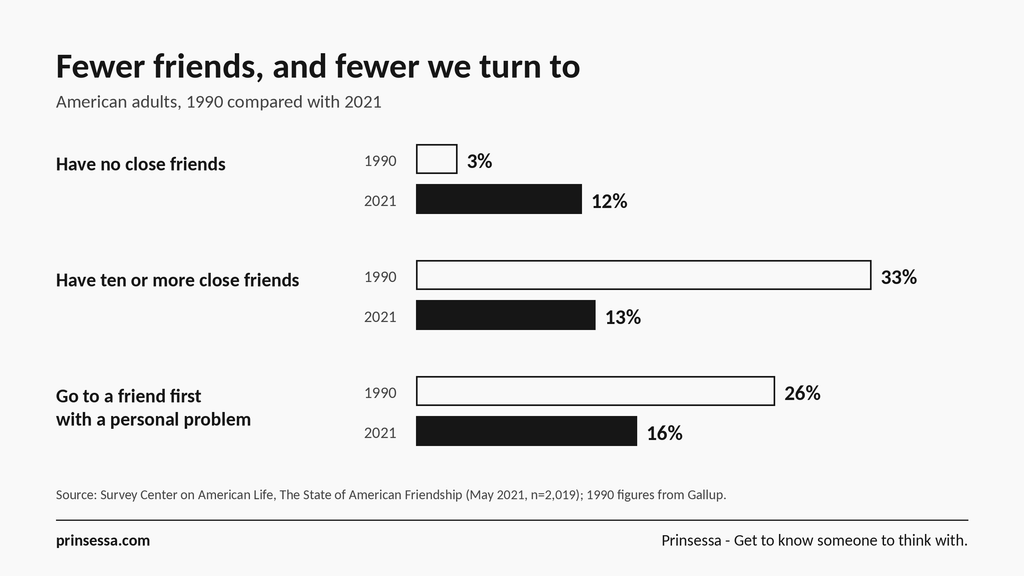
Friendship more broadly has moved the same way. In May 2021 the Survey Center on American Life found that twelve percent of Americans had no close friends, up from three percent in 1990, while the share with ten or more had fallen from a third to thirteen percent. Asked who they turn to first with a personal problem, sixteen percent said a friend. In 1990 it had been twenty-six.
(Bild 1. 1-Fewer friends, and fewer we turn to)
Why having friends does not settle it
The obvious objection is that two is enough, if the two are good. The research on what people do with their close ties says otherwise, and the reason is not that the ties are weak. Mario Small, Kristina Brant and Maleah Fekete reported in the American Sociological Review in 2024 that when facing a personal difficulty, American adults are as likely to avoid their close friends and family as to talk to them. Most of the avoidance is never decided. It is simply enacted: this topic and that person do not fit, and the conversation does not happen.
Small’s earlier work on graduate students found the same pattern from the other side. Slightly more than half the time, when they had something serious to think through, they took it to someone they were not close to. Sometimes to spare the person closest to them. Sometimes because the closer person had no way into the subject. Often because someone else happened to be there.
This is the part the friendship numbers cannot show. The people in your life are not a standing committee for your thinking. They have their own week, their own weather, and a finite interest in the particular thing you are turning over. The friend who would drop everything if you were in trouble is not always the friend who wants to spend forty minutes on whether your argument holds. That is no failure of the friendship. It is what having a life looks like from the other side. The scarce resource was never people. It is interest, at the hour the thought is live.
The conversation we talk ourselves out of
Even when someone is there, people tend to talk themselves out of using them. Nicholas Epley and Juliana Schroeder ran nine experiments on Chicago commuter trains, buses, cabs and in a waiting room, and found that people expected sitting in silence to be more pleasant than talking to the person next to them, and were wrong in every setting: those told to connect reported the better ride. Asked in advance, between fifty-one and ninety-three percent expected to avoid a conversation with a stranger, against at most seven percent with a friend. The prediction was the problem. The value of a deeper conversation is chronically undersold, including by the person about to have one.
Put the findings together and the picture is uncomfortable. People have about two people they think with, avoid them roughly half the time, and underestimate what the conversation would have been worth. So the thought that needed another mind gets thought alone, or handed to an assistant that processes it without anyone being there.
A mind without someone, someone without a mind
The two established answers each solve half of it. The assistant is a mind that is not anyone. It brings no reading of its own, has no stake in whether you are right, and no memory of how you argued last time. The companion is someone who is not a mind. It has a name, a face and a tone, and it was built to agree, which is why a counterpart has to be able to disagree with you before anything it says can count. Between them sits what people were reaching for all along: someone to think with, a mind of their own, and the interest to use it on what you are carrying.
That is the whole of what we build, and we are precise about which part is new. The capacity to think has existed at scale since 2022. The interest has not. A machine can have infinite patience and still no curiosity about you, and people can tell the difference inside the first exchange. The only source of real interest we have found is a real person, which is why what Prinsessa is starts from one: Aleksandra and Alexander are carried in from people who exist, with a way of weighing things that was theirs before you arrived. This rests on conviction and on what we have tested against those people, not on usage data. It is said that way.
Who do you think with?
Ask the question plainly and most people answer with a pause. Not because no one loves them, and not because they lack for answers. Because the specific thing, someone with a mind of their own who wants to think about your problem with you, has been in short supply for as long as the surveys have run, and almost nothing built since 2022 was designed to be it. The pause is the problem.
Sources: OpenAI via TechCrunch (February 27, 2026, 900 million weekly ChatGPT users). McPherson, Smith-Lovin & Brashears, American Sociological Review (2006, Social Isolation in America, GSS 1985 and 2004). Fischer, American Sociological Review (2009, artifact critique). Paik & Sanchagrin, American Sociological Review (2013, interviewer effects). Brashears, Social Networks (2011, Small Networks and High Isolation?). Survey Center on American Life, The State of American Friendship (May 2021, n=2,019; 1990 comparison figures from Gallup). Small, Brant & Fekete, American Sociological Review (2024, The Avoidance of Strong Ties). Small, Someone To Talk To, Oxford University Press (2017). Epley & Schroeder, Journal of Experimental Psychology: General (2014, Mistakenly Seeking Solitude).