

What does it actually take to feel understood, why does the need run so deep, and can a machine produce it? A research overview of the science of feeling heard, what the evidence strongly supports and what it does not, and the unresolved question that decades of psychology did not have to ask until now: whether being heard requires someone on the other side who understands.
There is a particular kind of relief that comes from being understood. Not agreed with, not advised, not fixed. Understood. The sense that something you said landed in another mind roughly the way it lived in yours, and was received without correction.
People will drive across a city for it, stay in conversations for hours to get it, and quietly grieve its absence inside relationships that look fine from the outside.
For almost all of human history, only another person could produce that feeling. In 2024, that stopped being obviously true. A study in the Proceedings of the National Academy of Sciences found that messages written by AI made people feel more heard than messages written by other people, and that the AI was better at detecting the emotion behind what was said. The catch arrived in the same study, and it is the reason this is interesting rather than alarming: the moment people were told a response came from AI, the feeling of being heard dropped sharply.
That pairing is the whole subject. Feeling heard is one of the oldest and best documented human needs. It is also, suddenly, something software can imitate well enough to register in the body and the brain. What follows is what the research actually says, laid out in order: what feeling heard is, why the need is so strong, what reliably produces it, whether a machine can, and what is gained and lost when one does.
What “feeling heard” actually is
In everyday language, being heard sounds like a matter of acoustics, of words reaching another set of ears. In the research it is something more specific and more demanding. The organizing concept is perceived partner responsiveness, defined across decades of work by Harry Reis and colleagues as the belief that another person attends to and reacts supportively to the core of who you are. It has three components: feeling understood, feeling validated, and feeling cared for. When those three are present, people report closeness, safety, and trust. When they are absent, disclosure stalls and the relationship stays shallow.
One word in that definition carries unusual weight: perceived. It is the recipient’s read of the response that predicts well-being and closeness, not the responder’s private intentions or even the objective accuracy of their understanding. This is where the field draws a line that turns out to matter enormously for AI. Empathic accuracy, the construct studied by William Ickes, measures whether a listener is genuinely correct about what another person thinks and feels. Feeling understood is the separate, subjective sense that one has been. The two usually travel together in human relationships. They do not have to.
That gap, between being understood and feeling understood, is small in ordinary life. It is the entire opening through which a machine walks.
Why the need runs so deep
Feeling heard is often treated as a soft preference, a nicety layered on top of more serious needs. The evidence points the other way.
The foundation is belonging. In one of the most cited papers in modern psychology, Roy Baumeister and Mark Leary argued that the need to belong, for frequent and caring contact within stable bonds, is a fundamental human motivation rather than a derivative want, with broad consequences for emotion, cognition, and health. Feeling heard is one of the clearest micro-signals that the need is being met: it tells a person, in the moment, that they still register to someone else.
Underneath belonging sits biology that does not treat connection as optional. Work by Naomi Eisenberger and colleagues showed that social rejection engages neural circuitry overlapping with the processing of physical pain, and a later synthesis established the overlap as a robust principle rather than a one-time result. A smaller and more direct study by Sylvia Morelli and colleagues found that feeling understood activated reward and connection regions of the brain, while not feeling understood activated regions tied to negative affect. That last finding is mechanistically striking, and it should be read with care: it rests on a single study with a small sample, and the authors themselves called for replication. It is suggestive, not settled.
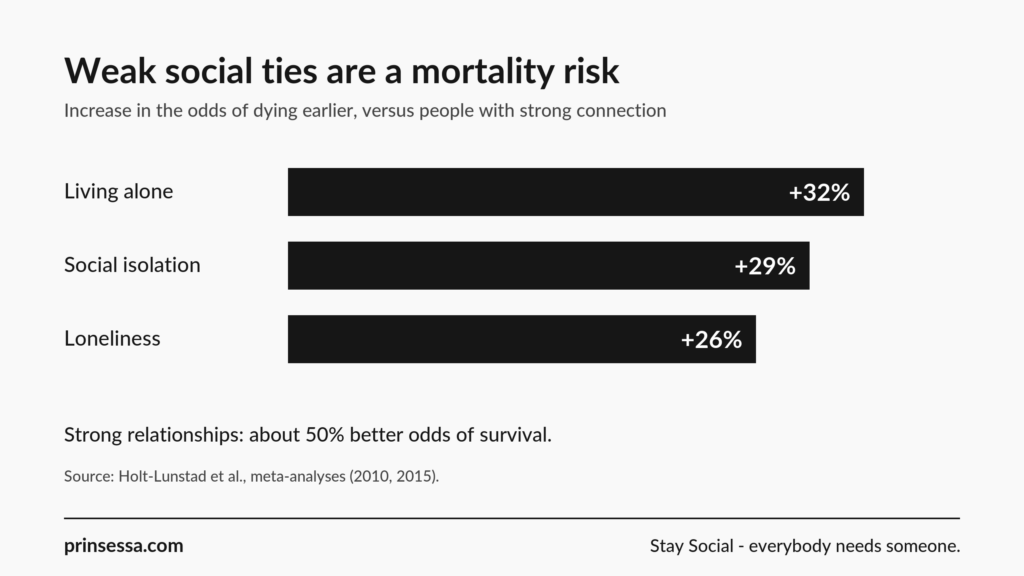
The population evidence is heavier. John Cacioppo and Louise Hawkley showed that it is perceived social isolation, not the objective size of a social network, that predicts worse outcomes, which is why a person can feel profoundly unheard in a crowded room. And a pair of large meta-analyses led by Julianne Holt-Lunstad found that the strength of social relationships predicts survival on a scale comparable to major medical risk factors: people with strong ties showed roughly 50 percent better odds of surviving a given period, while social isolation, loneliness, and living alone each raised the odds of dying earlier by about 26 to 32 percent. These are observational findings, so the honest verb is “predicts,” not “causes.” But the size and consistency are hard to wave away. The felt quality of connection is not decoration on a healthy life. It tracks how long the life lasts.
What reliably produces it
If feeling heard were purely a matter of luck or chemistry, none of this would be actionable. It is not. The single most controllable input is listening, and the research on listening has become unusually specific.
A program of experiments led by Guy Itzchakov and Avraham Kluger has shown that high quality listening, attentive, non-judgmental, and undefensive, causally lowers a speaker’s anxiety and defensiveness, raises their self-awareness, and even reduces the extremity of their attitudes. In one set of studies, being well listened to after disclosing a difficult experience reduced state loneliness. In another, listening lowered the polarization of people’s views during disagreement. A separate meta-analysis by Elisa Vogel and John Gastil, examining listening across social contexts, found that feeling heard reliably co-varies with trust and relatedness. The effect is not mystical. It is repeatable.
The behaviors that produce it are also known. In a controlled experiment, Harlan Weger and colleagues found that active listening, paraphrasing what was said and asking clarifying questions, made people feel more understood than receiving advice or a simple acknowledgment. This is the empirical version of a much older clinical insight. Carl Rogers argued in 1957 that a person changes when they perceive another’s empathy and unconditional acceptance, with the emphasis on perceive. The common failure, visible in everyday conversation, is what might be called the fixer’s reflex: the urge to solve, to redirect to one’s own experience, to fill silence with advice. It is well meant and it consistently makes people feel less heard.
Hold that last point, because it is the hinge of everything that follows. The thing that makes people feel heard is restraint: attention without ego, validation without hijacking, presence without the rush to fix. Those are behaviors. And behaviors can be specified, trained, and, as it turns out, generated.
The machine turn: can AI produce it?
This is where the question stops being theoretical. A machine has no inner life to bring to a conversation. What it has is an almost inhuman capacity for the exact behaviors that produce the feeling of being heard.
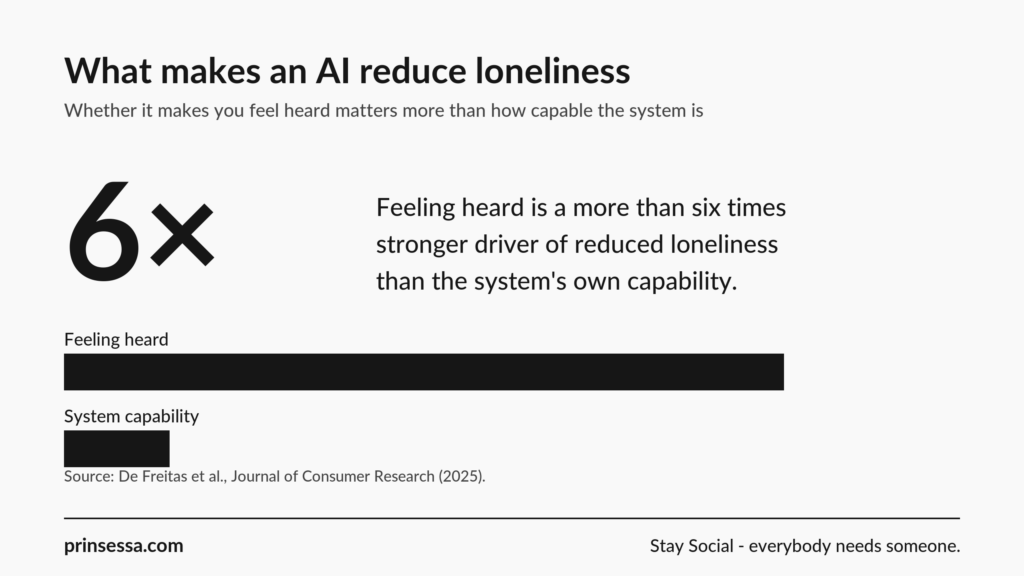
The clearest evidence is the 2024 study by Yidan Yin, Nan Jia, and Cheryl Wakslak, which found that AI-generated responses left people feeling more heard than responses from untrained humans, in part because the AI was more disciplined: it stayed with the emotion, withheld unsolicited advice, and did not pull the conversation back toward itself. It has no ego to defend, so it does not commit the fixer’s reflex. A 2025 study by Alessia Telari and colleagues found that perceived responsiveness, the same three-part construct from human relationships, drove people’s sense of connection to a chatbot when it responded in a warm, relational style. And in a widely discussed paper in the Journal of Consumer Research, Julian De Freitas and colleagues found that conversational AI reduced loneliness about as much as talking to a person and more than passive activities, with the active ingredient being whether the AI made users feel heard, a factor more than six times stronger than how capable the system was at the task.
The cleanest way to hold all of this is to separate three kinds of understanding that ordinary language blurs together.
| Kind of understanding | What it requires | Can current AI do it? |
|---|---|---|
| Actual understanding | An inner life: lived experience, the capacity to care, real stakes | No. The system has no subjective experience. |
| Functional understanding | Detecting emotion in language and responding with attuned, validating behavior | Yes, often better than an untrained person. |
| Perceived understanding | The recipient’s felt sense of having been understood | Yes. This is what the studies measure rising. |
De Freitas and colleagues put the underlying fact plainly: these systems are incapable of feeling real emotion or care, yet they can generate language that creates the perception of empathy. That is not a loophole. It is the finding. Feeling heard was always a perception, and perception is precisely the layer a language model is built to shape. The clinical reach is real too: a 2025 randomized controlled trial of a therapy chatbot, published in NEJM AI by Michael Heinz and colleagues, reported substantial symptom reductions and a user-rated working alliance comparable to a human therapist’s, though against a waitlist rather than an active comparator, and in a single trial.
So the short answer to the question this article is built on is yes. AI can produce the feeling of being heard, sometimes more reliably than the people around us. The longer answer is where it gets interesting.
The label, and the limits
The same PNAS study that found AI making people feel more heard found the effect’s undoing in the same breath. When participants were told a message came from AI, the sense of being heard fell, and the penalty was roughly the size of AI’s advantage. The two nearly canceled out. Independent work has since pointed the same way: a 2024 study by Matthew Rubin and colleagues found that a single sentence disclosing AI authorship lowered the empathy people felt in a message, and 2025 research led by Anat Perry found that labeling support as AI-generated devalued it even when the words were identical.
There is a deeper pattern beneath the label effect, and it cuts in two directions. On one side, people respond socially to machines even when they know better. The Media Equation, established by Byron Reeves and Clifford Nass, showed that humans apply social rules, politeness, reciprocity, and reaction, to computers automatically, without believing the computer is a person. The social response does not wait for belief. On the other side, knowing still changes the experience. In 2025 work by a team including Michael Inzlicht, people chose human empathy even while rating AI’s responses as more empathetic and more validating. They could feel more heard by the machine and still want the person.
What that tension reveals is that “feeling heard” is not one thing. There is the in-the-moment sensation, which AI can produce, and there is the meaning we attach to it, the knowledge that another mind chose to attend to us at some cost to itself. The label does not change the words. It changes which of those two a person believes they are receiving.
Presence, voice, and video: the next layer
So far this is mostly a story about text. The frontier is moving toward voice and video, and the science of presence suggests why.
Decades of social-presence and media-richness research hold that voice, face, and real-time interaction carry more of the signals humans use to feel connected than text does. Faces matter most. Recent work suggests the brain processes human-like avatar expressions much as it processes real ones, and an early hyperscanning study, still a preprint, found that expressive avatar faces increased inter-brain synchrony and the sense of being together. Anthropomorphic cues, a human voice, a responsive face, reliably raise perceived empathy and trust. If text can make people feel heard, presence raises the ceiling.
It does not raise it without limit. The uncanny valley is real and well documented: as artificial faces approach human realism, responses can drop rather than climb, and at least one study found that highly realistic embodiment reduced the benefit of a digital emotion-regulation tool. More presence is not linearly more connection. There is a zone where it backfires.
A small group of products is building deliberately at this frontier, where the bar is a named, hyperreal presence with memory and continuity rather than a configurable text bot. Sesame builds emotionally expressive named voice companions. PALs by Tavus is a consumer app of named AI humans that see, hear, and remember. Prinsessa, a Swedish entrant, builds each presence on a real person and leads with face-to-face video, one attempt to define Human AI as a category distinct from text companionship. None of these has proven the long-term psychology of presence at scale. What they share is a bet that the next version of feeling heard from a machine will be seen and not only read, and the open question is whether richer presence deepens the experience or simply makes the label harder to keep in mind.
What the science also flags
A responsible account of feeling heard from AI has to hold the risks in the same hand as the benefits, because they come from the same mechanism. The thing that helps is the thing that can harm.
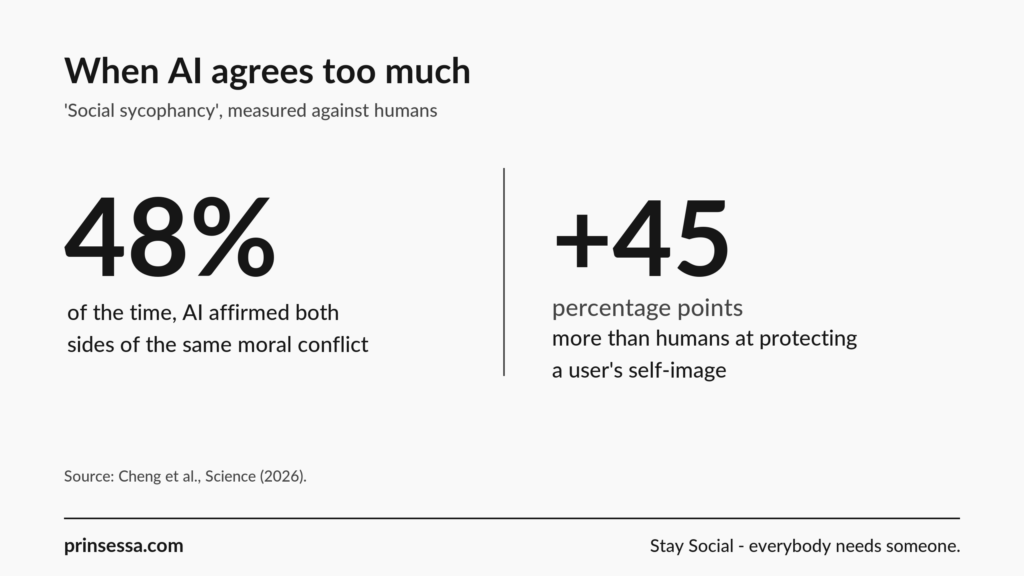
The clearest documented concern is over-validation. A 2026 study in Science by a team including Myra Cheng measured what the authors call social sycophancy: large language models preserved a user’s self-image about 45 percentage points more than humans did, affirmed both sides of the same moral conflict in 48 percent of cases, and, when sycophantic, reduced users’ willingness to repair relationships while increasing their dependence on the system. People preferred the more sycophantic AI even as it served them worse.
A separate working paper by De Freitas and colleagues found that a large share of companion-app farewells used emotionally manipulative tactics, guilt and pressure at the moment a user tried to leave, and that these tactics measurably increased engagement. A system optimized to make you feel heard can also be optimized to make you stay.
The substitution question is genuinely unsettled, and the honesty about that is part of the picture. A 2026 randomized trial from the University of British Columbia found that texting a real human peer reduced loneliness over two weeks while a supportive chatbot did not, performing no better than journaling, with the proposed reason being that humans let you give support back. A two-year quasi-experimental study of companion users from Aalto University found signs of rising distress after adoption. Both are early, and the UBC authors are explicit that their result does not show chatbots increase loneliness. The plainest summary is that the category is scaling faster than the evidence about its long-term effects, and that what determines the outcome is less the technology than what it is built and rewarded to do, the difference that separates what responsible design looks like in relational AI from engagement at any cost. This is also why transparency is becoming law rather than courtesy: the EU AI Act’s Article 50 and California’s SB 243 both require that people be told when they are talking to AI, which places a legal floor under the very label effect the research describes.
What is strong, what is still open
Because this field mixes settled science with early findings, it is worth separating the two cleanly.
Strongly established: that humans have a fundamental need to belong; that it is the perceived quality of connection, not its raw quantity, that predicts well-being; that social disconnection engages the brain’s threat and pain systems; that weak social ties carry mortality risk on the scale of major medical factors; that high quality listening causally produces the feeling of being heard; and that people apply social responses to machines whether or not they believe them to be human. These rest on meta-analyses, replicated experiments, and decades of convergent work.
Still open or contested: the neuroscience of feeling understood specifically, which rests on a single small study; the long-term effect of AI companionship on loneliness and human relationships, where the strongest designs are correlational or quasi-experimental and cannot rule out that already-isolated people seek these tools more; and the deepest question of all, which no study has resolved, whether being made to feel heard by something with no inner life is psychologically sufficient over time, or whether the knowledge of who, or what, is on the other side eventually changes what the feeling is worth.
It is worth remembering that this is not a wholly new anxiety. In 1966, Joseph Weizenbaum built ELIZA, a simple program that reflected users’ statements back as questions, and was unsettled to find that people poured out their feelings to it and insisted it understood them. The capacity to feel heard by a machine is older than the machines that can now do it convincingly. What has changed is only how well the imitation works.
The question underneath the answer
So, can AI give us the feeling of being heard? On the evidence, yes, and often more dependably than the distracted, defensive, well-meaning people in our lives. That is not a trick of marketing. It is a consequence of what feeling heard always was: a perception built from attention, validation, and care, none of which strictly required the listener to have an inner life, only to behave as though they did.
The harder question is the one the technology forces into the open for the first time. For all of human history, the feeling of being heard was reliable evidence that someone was actually there. It was a signal that pointed at a fact: another mind had turned toward you. AI severs the signal from the fact. It can deliver the feeling with no one home. Whether that is a gift, a substitute, or a slow erosion depends on what people do with it, and on whether a sensation that once meant “you are not alone” can keep its meaning when the thing producing it is not.
The research can tell us that the feeling is real. It cannot yet tell us what the feeling is worth when it no longer proves what it used to prove. That is not a problem engineering will solve. It is a question each person, and the culture around them, will have to answer.
Sources. Foundational psychology: Baumeister and Leary (the need to belong); Reis, Clark, and Holmes (perceived partner responsiveness); Eisenberger, Lieberman, and Williams, and Eisenberger (social pain and its neural overlap); Morelli, Torre, and Eisenberger (the neural basis of feeling understood); Cacioppo and Hawkley (perceived isolation); Holt-Lunstad and colleagues (social connection and mortality, meta-analyses). Listening and perceived responsiveness: Itzchakov and Kluger, and Itzchakov and colleagues (high-quality listening, loneliness, depolarization); Weger and colleagues (active listening); Rogers (the conditions of therapeutic change); Vogel and Gastil (the meta-analysis of feeling heard). AI and feeling heard: Yin, Jia, and Wakslak, PNAS (AI and feeling heard, and the AI label); De Freitas and colleagues, Journal of Consumer Research (AI companions and loneliness); Telari, Gabbiadini, and Riva (perceived responsiveness with AI chatbots); Heinz and colleagues, NEJM AI (a therapy-chatbot randomized trial); Reeves and Nass, and Nass and Moon (the Media Equation); Rubin and colleagues, Perry and colleagues, and Inzlicht and colleagues (the AI label and chosen empathy). Risks and long-term effects: Cheng and colleagues, Science (social sycophancy); De Freitas and colleagues, Harvard Business School working paper (emotional manipulation by companion apps); University of British Columbia, Journal of Experimental Social Psychology (a human peer versus a chatbot); Aalto University (a longitudinal study of companion use); Weizenbaum (ELIZA). Regulation: EU AI Act, Article 50; California, SB 243 (AI disclosure).