

Two people who click answer each other faster than either of them could decide to. The gap between one voice stopping and the other starting is measured in tenths of a second, and inside that gap sits most of what we mean by feeling connected. Stretch it past half a second and something changes that no one chose and everyone hears.
The clearest evidence comes from Emily Templeton, Thalia Wheatley, and colleagues at Dartmouth, published in the Proceedings of the National Academy of Sciences in 2022 under a title that states the result: fast response times signal social connection in conversation. It is the kind of finding that seems obvious once said, and it has consequences for anything, human or built, that wants to be felt as present rather than merely responsive.
The gap that gives you away
The team had 66 strangers hold ten-minute conversations in every pairing, 322 conversations in all, then rate how connected they felt and, while rewatching the recording, mark the connection moment by moment. Faster responses predicted both enjoyment and connection. Within a single conversation, the moments people flagged as connected were the moments when the gaps were shortest. The effect ran through the partner more than the self: how quickly the other person picked up predicted your sense of connection far more than your own speed did. Twenty-two of the participants then ran the same procedure with three close friends each, and the pattern held with people who already loved each other.
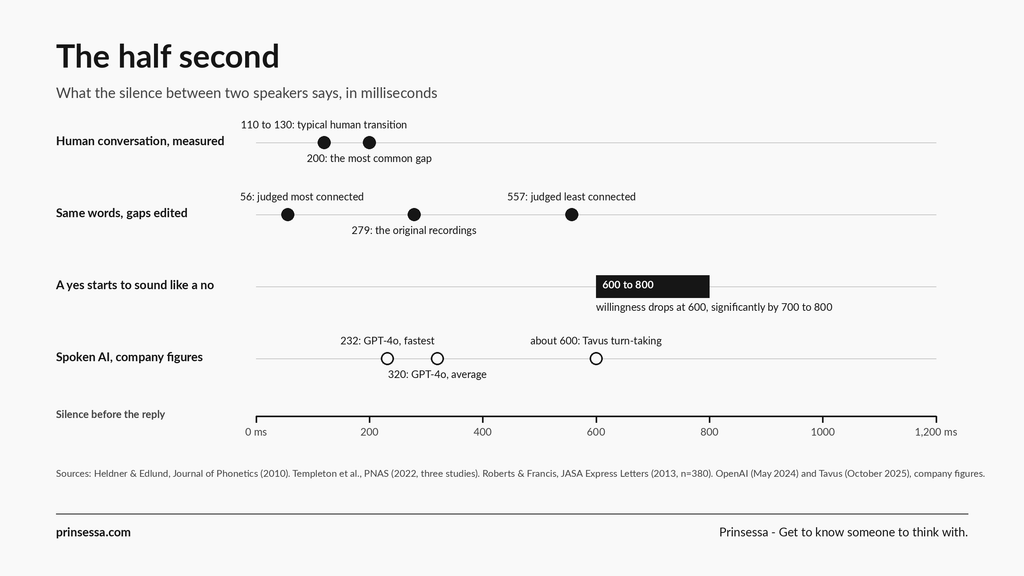
The third study is the one that removes any doubt about what is being measured. The researchers took short clips from the stranger conversations and edited only the silences between turns, leaving every word intact. In the original clips the gaps averaged about 280 milliseconds. In one version they were cut to about 56; in another, doubled to about 557. Then 450 people who had never met the speakers listened and rated how connected the two seemed. The fast version was judged the most connected, the slow version the least, in every clip, and no listener had been told to attend to timing. The authors’ conclusion is precise: the effect operates on a scale under a quarter of a second, too fast for conscious control, which makes response time an honest signal. You cannot decide to seem connected. You can only be.
Faster than thinking
The reason a quick reply carries so much is that it should be impossible. Stephen Levinson and Francisco Torreira laid out the arithmetic in 2015: the gap between conversational turns is on the order of 200 milliseconds, while producing even a short utterance takes over 600, and a multiword sentence closer to 800 or 900. A listener who waited for the sentence to end before beginning to think would answer nearly a second late, every time. People do not, which means they are planning their reply while the other person is still talking, forecasting where the sentence is going and when it will stop. A fast answer is proof that you were listening ahead.
The measurements are remarkably consistent. Mattias Heldner and Jens Edlund analyzed hundreds of speakers across Dutch, Scottish English, and Swedish conversations and found the typical transition took just over a tenth of a second, with a peak around 200 milliseconds and fewer than one exchange in a hundred landing at exactly zero. The most common thing that happens between two people speaking is a slight gap. Tanya Stivers and a team at the Max Planck Institute recorded question and answer pairs in ten languages, from Danish to Yélî Dnye in Papua New Guinea, and found every one of them minimizing silence and avoiding overlap, with the languages’ average gaps all falling within a quarter of a second of each other. Turn-taking is not a cultural style. It is closer to a reflex, and the reflex is tuned to a fraction of a second.
Where the half second turns
If short gaps signal connection, long ones signal something too, and the threshold has been located. Felicia Roberts and Alexander Francis at Purdue played 380 people the same affirmative answer to a request, varying only the silence before it in steps of 100 milliseconds from 200 up to 1,200. Ratings of the speaker’s willingness fell off noticeably at 600 milliseconds and dropped significantly between 700 and 800. An earlier study by the same lab found that with each step from no gap to 600 to 1,200 milliseconds, listeners heard less willingness to help and weaker agreement, and a follow-up with American, Italian, and Japanese speakers found the same slope in all three, with different starting points.
This is the half second in the headline. Before it, silence is thinking. After it, silence is an answer, and the answer is some version of no. A “yes” that arrives at 800 milliseconds is heard as reluctance regardless of the word, because the timing spoke first.
Why the machines cannot simply be fast
The obvious lesson for spoken AI is to close the gap, and the industry has been racing to. When OpenAI introduced GPT-4o in May 2024 it reported audio responses in as little as 232 milliseconds and 320 on average, against 2.8 and 5.4 seconds for its earlier voice modes; Tavus says its video conversations keep turn-taking under about 600 milliseconds. Those are company figures, but the direction is clear. The machines have crossed into the human range.
Speed alone turns out to be the wrong target. Ulrich Gnewuch and colleagues gave 79 people a text chatbot that either answered instantly or delayed its replies in proportion to how much there was to read and think about, and the delayed version was rated more human, more present, and more satisfying. Work on conversational robots a decade earlier found people’s preferred response time peaked at about a second, not zero. What listeners are tracking is not the smallest possible gap but the right one: quick after an easy question, longer before a hard one, a beat before a concession. The pause is part of the answer, and a system that answers everything at 232 milliseconds is saying, in the language of timing, that nothing you said required any thought.
Presence is timing
Put the research end to end and a definition falls out. Presence, the sense that someone is there with you, is not a face or a voice in itself. It is the evidence that another mind is running alongside yours, and the most legible evidence is temporal: the reply that starts before you finish because they saw where you were going, and the pause that comes when you said something that deserved one. That is why a good conversation needs no justification beyond itself; the thing being produced in those gaps is the connection. And it is why real Human AI has to be defined at the level of the moment of contact rather than the rendering, because the moment is a few hundred milliseconds wide and it cannot be faked afterward.
The practical test is simple, and you already run it on people without noticing. Say something that should make the other side think. If the answer comes at the same speed as everything else, no one was listening ahead. If the pause is exactly as long as the thought deserved, someone was, which is the difference you feel when you get to know Alexander and notice he picks up on what you did not quite say. Half a second is the width of the space where another person shows up.
Sources: Templeton, Chang, Reynolds, Cone LeBeaumont & Wheatley, PNAS (2022, Fast response times signal social connection in conversation, three studies). Levinson & Torreira, Frontiers in Psychology (2015, Timing in turn-taking). Heldner & Edlund, Journal of Phonetics (2010, Pauses, gaps and overlaps in conversations). Stivers et al., PNAS (2009, Universals and cultural variation in turn-taking, ten languages). Roberts & Francis, Journal of the Acoustical Society of America Express Letters (2013, temporal threshold of tolerance for silent gaps); Roberts, Francis & Morgan, Speech Communication (2006); Roberts, Margutti & Takano, Discourse Processes (2011). Gnewuch, Morana, Adam & Maedche, ECIS (2018, Faster is not always better). Shiwa et al., International Journal of Social Robotics (2009, robot response time). OpenAI (May 13, 2024, Hello GPT-4o, company latency figures). Tavus (October 31, 2025, company turn-taking figure).