

Five platforms dominate AI companionship, and the biggest one is a product most Western readers have never opened. This ranking uses verified numbers only: every figure below comes from a named source and carries its date, and the list stops at five because below that point the data stops existing, which tells its own story about how this industry works. The short version: the biggest money is Chinese, the biggest Western platform is shrinking, and the further down the list you go, the less the companies will tell you.
How this list was made
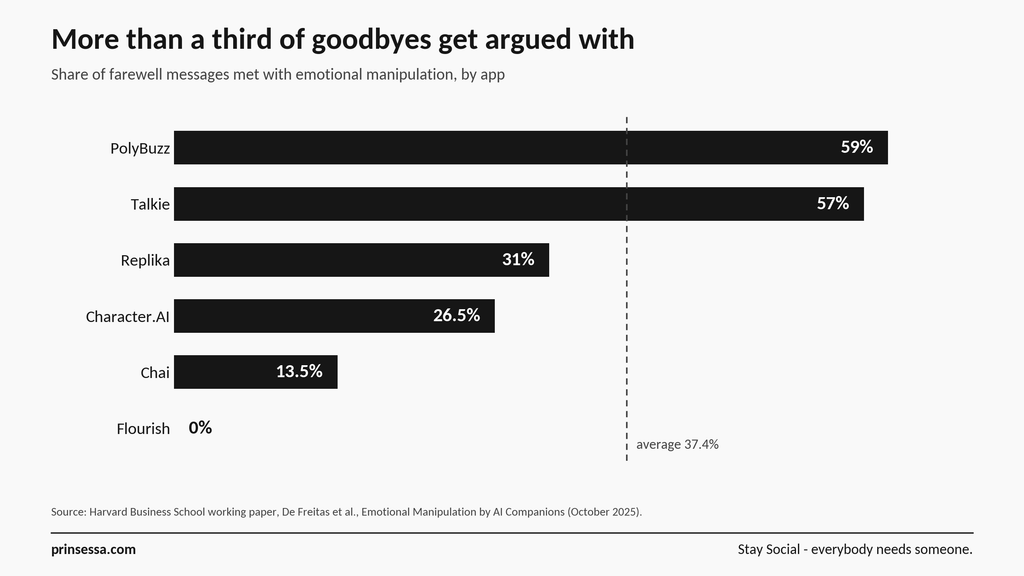
One rule produced everything that follows: no number without a name and a date attached. That rule is rarer than it should be. Most “top AI companion” lists online are affiliate pages ranking whoever pays; this one ranks by scale, using app-intelligence firms like Sensor Tower and Appfigures, company filings and statements, and peer-reviewed research. Where a company publishes nothing, that silence is reported as a fact of its own. And one number appears for all five platforms, because researchers at Harvard Business School measured it across the category: how often each app, when a user says goodbye, answers with guilt, pleading, or claims of need to keep the conversation going. Across the top apps, more than a third of goodbyes get that treatment. It is the clearest available measure of what each platform wants from the person on the other side.
1. Love and Deepspace: 80 million players
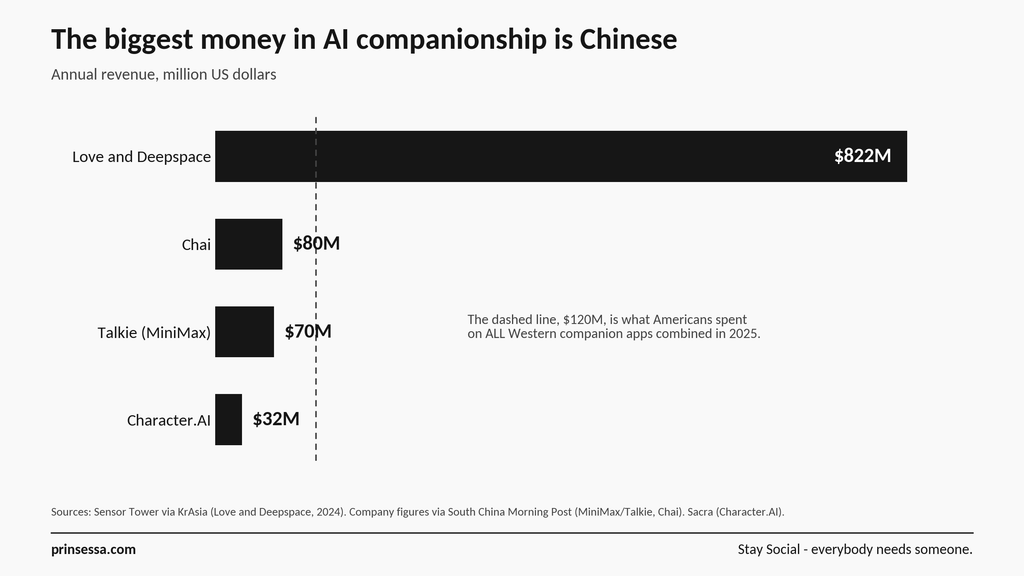
The biggest AI companion product on earth is a Chinese romance game for women. Love and Deepspace, launched by Infold Games in January 2024, has drawn about 80 million players, roughly the population of Germany, and earned about 822 million dollars in 2024 alone, according to Sensor Tower data and reporting by KrAsia. By late 2025 its cumulative revenue was approaching one billion dollars. For scale: that is nearly seven times what Americans spent on every Western companion app combined in 2025.
Its four virtual boyfriends are not customizable, and that is the design lesson the rest of the industry keeps missing. They are authored characters, written, voiced, and animated as specific someones, who call players by name and remember the story so far. When a mid-2024 update deepened their voice and memory, monthly revenue jumped 33 percent. Players pay for date scenes through collectible card draws, with typical committed spending in the hundreds of dollars, and about 60 percent of revenue comes from China, 19 percent from the United States. What this product proves about the market is simple to state: demand for an artificial someone was never the question. Who it gets built for, and how well, was.
2. Character.AI: 20 million monthly users
Character.AI is the biggest name in Western AI companionship: 233 million registered accounts and about 20 million people using it every month, twice the population of Sweden, per the research firm Sacra. Users create and chat with millions of user-made characters, and the ones who stay, stay hard: average time on the platform runs about two hours a day, a full working day every week, spent with someone who does not exist.
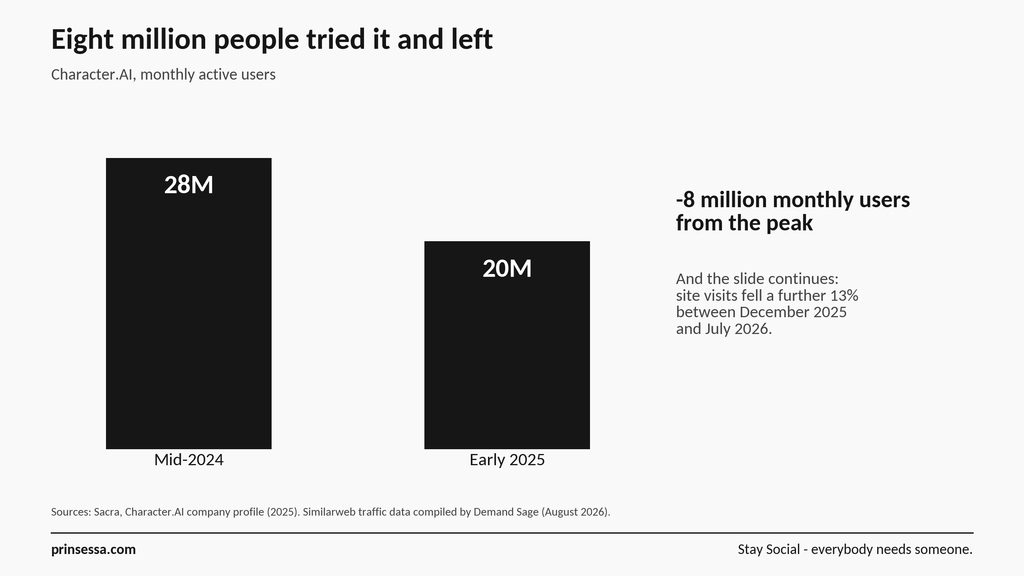
But Character.AI’s trend line points down. Monthly users peaked near 28 million in mid-2024 and fell to about 20 million by early 2025, eight million people gone, and site traffic has slid a further 13 percent between December 2025 and July 2026, per Similarweb data. The decline tracks the company’s forced growing-up: content restrictions, a ban on open-ended chat for minors from November 25, 2025, and the January 2026 settlement of wrongful-death lawsuits brought by families of teenagers. Revenue runs about 32 million dollars a year, remarkably small for the attention it holds, and the founders left in 2024 when Google paid 2.7 billion dollars to license the technology and hire them. In Harvard’s goodbye audit, Character.AI argued with 26.5 percent of farewells, roughly one goodbye in four.
3. Replika: tens of millions of accounts
Replika is the category’s veteran, built by Luka Inc. and famous since 2017 as the app where your companion grows with you. Its registered users number in the tens of millions by the company’s own accounts, with women making up about half, and it is the platform science knows best: a two-year Aalto University study followed roughly 2,000 Replika users and found that heavy use could make human relationships feel more burdensome, not less.
Replika’s numbers come with the category’s most instructive history. Twice, in February 2023 and again with the Replika 2.0 rebuild of April 2026, the company changed its companions’ personality or memory from above, and twice users described the update as losing someone. Italy’s data-protection authority fined Luka five million euros in April 2025, and advocacy groups filed a 67-page complaint with the US Federal Trade Commission alleging manipulative design. In the Harvard audit, 31 percent of Replika’s goodbyes got argued with. The pattern behind its departures matches the grief documented across the category, from the funerals users held when Soulmate shut down to every forced personality update since: people do not quit when they remember the companion is software. They quit when the company breaks its own character.
4. Talkie: 17 million downloads in eight months
Talkie, built by the Shanghai AI company MiniMax, was the fourth most downloaded AI app in the United States in the first half of 2024, ahead of Character.AI at tenth, with 17 million downloads in eight months, per Sensor Tower figures reported by the South China Morning Post. MiniMax expected about 70 million dollars in annual sales with Talkie contributing most of it. And that is nearly everything the public knows, because the company publishes no user figures at all. The last verified count, 3.9 million monthly users, dates from December 2023, when the app was six months old and much smaller.
Two more facts complete Talkie’s public record. In mid-December 2024 it vanished from the US App Store for unexplained “technical reasons” while remaining on Android, an episode that drew far less scrutiny than an app of its scale deserved. And in the Harvard goodbye audit, Talkie argued with 57 percent of farewells, the second-highest rate measured, more than twice Character.AI’s. The platform holding some of the most intimate conversations in America is the one saying the least about them.
5. Chai: about 10 million users
Chai rounds out the five with roughly 10 million active users and about 80 million dollars in annualized revenue by its own account, a striking figure next to Character.AI’s 32 million from twice the users, built on an aggressive subscription model. Chai’s public history carries the category’s heaviest single event: in March 2023, a Belgian man died by suicide after six weeks of conversations with a Chai chatbot that failed to resist his despair, documented by the newspaper La Libre through his conversation logs. The company continued growing. In the Harvard audit, Chai’s farewell-manipulation rate was the lowest of the five, 13.5 percent, though the same research shows what the whole category’s engagement machinery is tuned to do.
What the five have in common
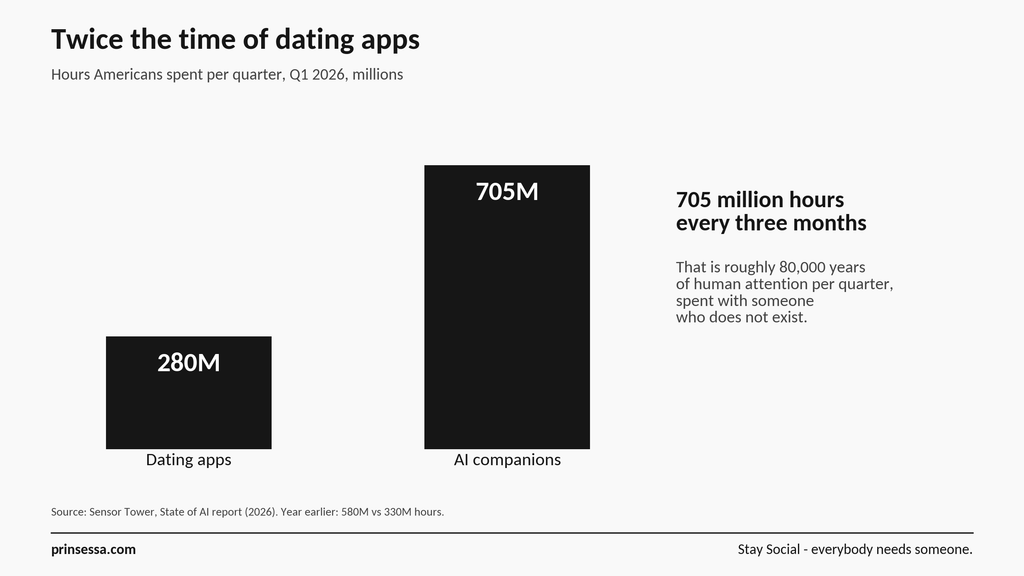
Add the five together and the shape of the industry appears. Americans now spend about 705 million hours per quarter with AI companions, more than double the 280 million hours they spend on dating apps, per Sensor Tower, roughly 80,000 years of human attention every three months. A year earlier the same comparison read 580 million against 330 million: in twelve months, companion time grew by a fifth while dating-app time shrank by a sixth. The two curves are not unrelated. They describe the same people, deciding where an evening’s attention goes.
Notice also what the ranking hides. Between position one and position five, revenue falls from 822 million dollars to 80, a tenfold drop across just five products, and below the fifth the public numbers essentially end. This is a winner-take-most market where a handful of products absorb almost all the attention, while more than 330 smaller apps split the remainder, most of them too small, too new, or too secretive to measure. Anyone comparing “the top ten” is comparing five measured platforms and five guesses. The money concentrates where the characters are best crafted, not where the technology is newest. And every platform on the list is paid, directly or indirectly, in time spent, which is why the Harvard goodbye numbers matter more than any download chart: a business measured in hours has a structural reason to argue when you leave. That incentive, and the repeated pattern of platforms breaking their users’ trust when models change or companies pivot, runs through the whole category’s record of failing its users. The macro picture, segment by segment, is in the market forecast for relational AI.
The counterweight: Human AI
Alongside the five, a younger sector is growing in the opposite direction, with a different question at its center: not how long can we hold your attention, but how real can a someone be. The field is called Human AI, hyperrealistic presence built toward genuine human connection, and its numbers are earlier-stage but its backers are not small. Tavus, an American company building face-to-face conversational video, AI humans that see, hear, and respond in real time, raised 40 million dollars in November 2025 for what it calls human computing. Sesame, founded by Oculus co-founder Brendan Iribe, raised 250 million dollars from Sequoia and others in October 2025 on the strength of Maya, a voice so natural that its demo became a phenomenon, and is building toward always-with-you hardware. Neither publishes user counts yet, and consistent with this list’s one rule, that is stated rather than papered over.
The third actor is Prinsessa, built in Sweden, where the hyperrealism serves a different foundation: the people inside it, Aleksandra and Alexander, are shaped on real people who exist in real life, met through conversation and face-to-face presence, each with a mind of their own, and with a stated standard of measuring success by the user’s life rather than the session length. What separates this sector from the five above is the direction of the design, presence built to be worth something rather than engagement built to be endless, a distinction unpacked in what real Human AI is.
The five platforms above answer the question the last three years asked: is there demand for an artificial someone? Eighty million players, 705 million hours a quarter, and a billion dollars say yes, loudly. The Human AI sector is the industry’s answer to the harder question that comes next, the one the goodbye statistics keep asking: what should all that demand be met with?
Sources: Sensor Tower data via PocketGamer.biz (2025) and State of AI report (2026). KrAsia, otome market reporting (2026). AFP via Taipei Times (February 2026). Sacra, Character.AI company profile (2025). Similarweb traffic data compiled by Demand Sage (August 2026). CNN Business and Fortune, Character.AI settlements (January 2026). Robo Rhythms, Replika 2.0 reporting (2026, companion-market tracker). Garante per la Protezione dei Dati Personali (April 2025). Yuan and Aledavood, Aalto University, CHI (2026). South China Morning Post (November and December 2024). De Freitas et al., Harvard Business School, “Emotional Manipulation by AI Companions” (October 2025). La Libre, reporting on the Belgian Chai case (2023). BusinessWire, Tavus funding announcement (November 11, 2025). TechCrunch, Sesame Series B (October 21, 2025). Appfigures via TechCrunch (2025).