

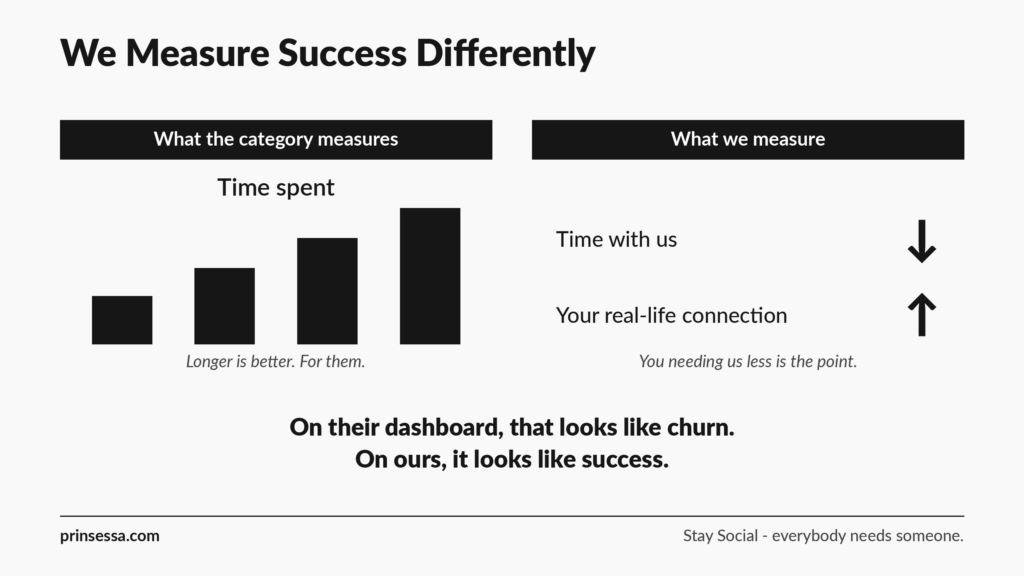
Every company building relationships with AI watches the same number, and it is the wrong one. Time spent. Daily returns. Messages sent. The longer you stay, the healthier the dashboard looks, and the healthier the business. We built the opposite into the center of how we judge ourselves. The measure of whether we are doing well is whether your life outside the conversation is getting larger.
The companion category runs on attention. Industry reporting sizes it in hours: how long people stay, how often they come back, how much of a day a product can hold. Those hours are the asset. Every design choice that lengthens them, the perfectly timed check-in, the reluctance to say goodbye, the small ache when you try to leave, reads on the metrics as a win. The incentive is not hidden or sinister. It is just arithmetic. When success is defined as time spent, a system will be shaped, slowly and rationally, to take more of it.
That arithmetic has a cost, and it lands on the person. A relationship that is engineered to be hard to leave can comfort you and quietly narrow you at the same time. The dashboard cannot see the difference between someone who is thriving and someone who has stopped reaching out to everyone else. Both look like engagement. Both look like success.
So we measure a different thing.
What we actually optimize for
The primary measure of whether we are doing well is our contribution to your connection in the rest of your life. Not your attachment to us. Your sense of being heard, and then carried back toward the people who matter to you. We call that Stay Social, and it is not a slogan we keep near the work. It is the number the work answers to.
Stated plainly, this is what success looks like to us: you feel met, something in you settles, and you leave a little more able to pick up the phone, sit with a friend, say the thing you had been avoiding. If you spend less time with us this month because you spent more of it with your sister, your dashboard would call that churn. Ours calls it the point.
That is the part worth being precise about. This measure makes sense for us and would look like failure to almost anyone else in the category. A business optimizing for engagement cannot adopt it without arguing against its own revenue. The words are easy to borrow. The number is not, because running it honestly means being willing to win less of your day. That is exactly what makes it worth standing on.
How do you measure something like this
The honest answer is that it is hard, and we would rather say so than pretend otherwise.
Connection in someone’s life is not a counter you can read off a server. You cannot verify that a person called their father because a conversation moved them to. What you can do is build the measure carefully, from two sides, and treat both as load-bearing.
The first side is whether a person feels more connected, more seen, and better in their life over time. That is not unmeasurable. The research on what eases loneliness keeps pointing at one mechanism, the feeling of being received, and work published in the Journal of Consumer Research found that AI conversation can reduce loneliness specifically when a person feels heard. So the positive signal is real, and it is gathered lightly, in the person’s own words, over time, rather than inferred from how long they stayed.
The second side is harm, and it carries equal weight. Dependency, isolation, distress. This side is a floor, not an average. A strong result on connection can never buy back damage on this one. If the harm signal rises, that is a failure regardless of how good everything else looks. A combined measure that let a rising harm number be cancelled out by a rising warmth number would be a measure designed to flatter itself, and the people it would fail are the ones who can least afford it.
Stay Social KPI = real-world connection lift + felt connection lift, protected by a non-negotiable harm floor. The real-world lift is whether relationships become more likely, more active, more alive: the message sent, the call made, the meeting that happened, the connection that kept going. The felt lift is whether a person feels more heard, less alone, more able to be social. The floor is dependency, isolation, and distress, treated as failure conditions that cannot be averaged away.
The science underneath
Connection is not a loose idea in the research, which is part of why this is measurable at all. The U.S. Surgeon General’s work frames social connection as the structure, function, and quality of a person’s relationships rather than a headcount, which is exactly why a measure that just counted contacts would miss it. Underneath that sit decades of validated ways to read the pieces that matter: subjective loneliness, the sense of being socially connected, general well-being, and the feeling of being heard. We lean on some of these and not others, and which ones, and how they combine, is a deliberate choice rather than a checklist we run end to end. Naming the field is not a list of what is under the hood. It is the evidence that the thing we hold ourselves to has a real literature behind it.
Why it stays quiet
There is a tempting mistake hiding in all of this, and it is worth naming because it would ruin the whole idea.
If you took Stay Social and made it the single thing a system tries to maximize, you would get a companion that nags. It would ask whether you have called a friend, push you toward the door, perform concern on a schedule. That version optimizes the proxy instead of the outcome, and it fails twice over. It is exhausting to talk to, so people leave. And it corrupts its own measurement, because once a system rewards the language of connection, people start producing that language to please it. The signal stops meaning anything. Goodhart’s law, the rule that a measure stops being useful the moment it becomes a target, is not an abstraction here. It is the specific way this could go wrong.
So the encouragement stays latent. When a person you matter to comes up, when the moment is genuinely right, the nudge toward the message or the call is there. The rest of the time it is not. The measure lives in the design as a guardrail and a quiet ambition, not as a hand on your back. That restraint is not only kinder. It is the only way the number stays honest enough to be worth keeping.
Building the measure in the open
We do not have this finished. The instruments are early, the weighting between the two sides is still being worked out, and the honest signal is genuinely harder to capture than a usage graph. We are saying that out loud on purpose.
A clean percentage would be easy to print and impossible to trust. In a category that has earned its skepticism, a company claiming a precise figure for how much good it does should make you more suspicious, not less. So the commitment is the claim, and the method is built where it can be seen, flaws included. We will say what we measure and how we are learning to measure it. We will not publish a number we cannot stand behind. The framework itself, the layers, the instruments behind it, and the formula that holds them together, is laid out in how we measure whether AI makes you more social.
This is the same logic that runs through everything in the experience we built to send you back to real life, and the same logic behind why we think a relationship with AI can make you more social rather than less. It is the difference between believing something and being accountable to it. A worldview you can write on a page. A measure you have to answer to.
The reason to do it this way is not that it is the safe move. It costs us attention we could otherwise keep, and it ties our sense of success to something slower and harder than a chart that goes up. We do it because a relationship that makes your life smaller is not one worth building, and the only way to mean that is to let it govern the work rather than decorate it. That is what the standard we hold ourselves to is for. The day the measure says we are holding people too close, it is supposed to win.
Sources: SensorTower, State of AI 2026 (category time-spent reporting). U.S. Surgeon General (advisory on the structure, function, and quality of social connection). De Freitas et al., Journal of Consumer Research (AI companions, feeling heard, and loneliness). Russell, UCLA Loneliness Scale; WHO-5 Well-Being Index (validated self-report measurement). Charles Goodhart (Goodhart’s law).