

People tell a screen things they would never say to a face, and they feel closer to the face. Both are measured, both are large, and together they explain something about video that the industry keeps getting backward: a face does not make you open up. It makes what you say count.
You say more to no one
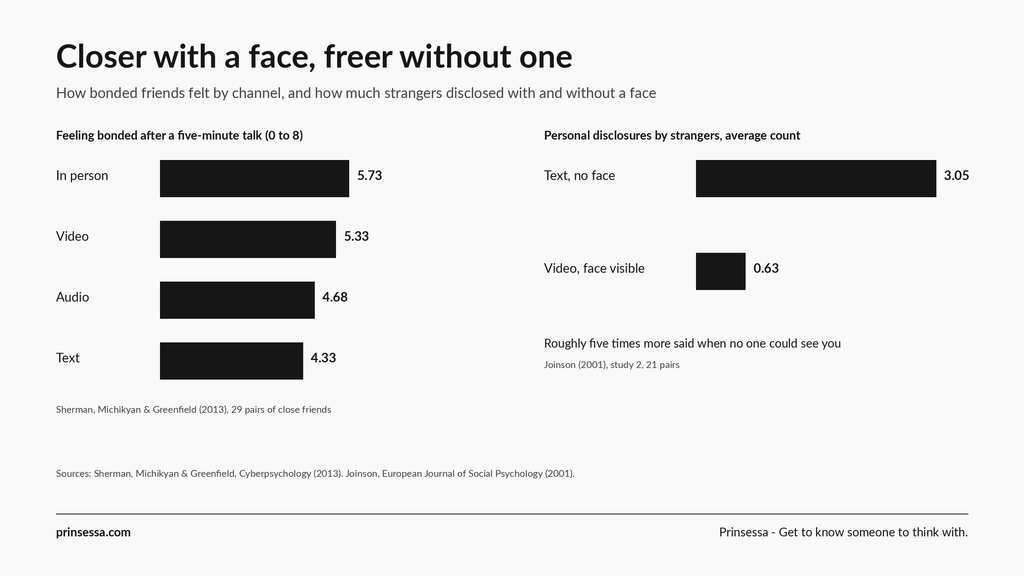
Adam Joinson at the Open University ran the experiment that put a number on it. Pairs of strangers discussed a moral dilemma either face to face or through a text link, and the text pairs disclosed more than four times as much about themselves: an average of 3.1 personal disclosures against 0.7. When he repeated it with a video link instead of a room, the result held. People typing to an unseen partner made 3.05 disclosures on average; people who could see each other on video, 0.63. Removing the face multiplied what people were willing to say by roughly five.
John Suler gave the pattern its name, the online disinhibition effect, and listed its causes: anonymity, asynchrony, and, at the center, invisibility. When no one can see you, the part of you that monitors how you are landing goes quiet, and things come out. The effect survives the move to machines. In a 2023 study, 111 adults were interviewed about an embarrassing personal event by an on-screen avatar that either had a human face or was a faceless sound wave. The faceless one got more information, and better information. Whether people believed a human or a computer was running the interview made no difference. The face did.
So the first half of the finding is blunt. If the goal is to get a person to say the most, take the face away.
And you feel more with someone
The second half runs the other direction. Lauren Sherman, Minas Michikyan and Patricia Greenfield at UCLA had 29 pairs of close friends talk for five minutes in each of four ways: in person, over video, over audio, and by instant message. Then each friend rated how bonded they felt. In person scored highest at 5.73 on the scale, video next at 5.33, audio 4.68, and text last at 4.33. The signals of affiliation the researchers coded, real smiles, laughter, nods, gestures, fell off a cliff across the same four channels, from strongly present in the room to almost absent in text. The sample was small and homogeneous, 58 female undergraduates, and the effect was still clear: the more of the other person you could see, the closer you felt.
The brain agrees. A team at Beijing Normal University measured ten pairs of people with near-infrared imaging while they talked, and found that their brain activity in a region of the left frontal cortex synchronized during face-to-face dialogue and did not during the same dialogue held back to back, nor during monologue in either position. The synchrony came from what a face makes possible: reading the other person’s expression as you speak, and taking turns on the strength of it. Atsushi Senju and Mark Johnson have shown that eye contact in particular is processed on a fast track, changing how the brain handles whatever comes next, which is why a look can alter the meaning of a sentence before the sentence is over.
The face is a witness
Put the two halves together and the contradiction dissolves. Disclosure and closeness are not the same thing, and a face trades one for the other. You say more to a blank channel because nothing you say costs anything: no one flinches, no one softens, no one is there to have heard it. You say less to a face because everything costs something, and the cost is exactly what makes the exchange matter. A confession into the void is free. A confession to a person who is looking at you is a thing that happened between two people.
That is what a face is for in conversation. Not information; the voice carries emotion at least as well, and one line of research has found that adding video to a call slightly reduces how accurately people read each other’s feelings. A face is a witness. It makes you answerable to someone for what you say, and being answerable is the difference between talking and being with.
It also means a face has to behave like a person’s, not a camera’s. Jeremy Bailenson’s analysis of why video meetings exhaust people put the first cause at eye contact held too close for too long: a face on a laptop screen fills the visual field the way a person standing half a meter away would, inside the distance that in ordinary life is reserved for intimacy, and it looks straight at you for the whole meeting, which no listener in a room ever does. A face that stares is not a witness. It is a surveillance camera with a smile. The research on gaze shows how fine the margin is: people register eye contact as broken when the other person’s gaze drops about ten degrees, and a camera mounted just above the screen keeps the reading accurate noticeably more often than one set to the side. A real face looks away to think, comes back to check, holds you when it matters. The holding means something because it is not constant.
What this means for a face on a screen
The lesson for anyone putting a face on an AI is not the one the pitch decks draw. If a system with a face is getting people to disclose more than they would to a blank chat window, something is wrong with the face, because the research says a face should do the opposite. Disclosure is what the faceless channel draws out; it is the cheap thing. A face on a screen that harvests confessions is doing the work of the void while dressed as a witness.
The harder and more valuable thing a face can do is make the conversation count, which requires that there be someone behind it who is answerable in return: someone who reacts, remembers, holds a view, looks away and comes back. That is the definition of presence that real Human AI is built toward, and it is why face-to-face video is simply included in a conversation with Aleksandra or Alexander rather than sold as a feature. It is also why the quality people notice when they get to know Aleksandra is the reverse of Joinson’s finding: with her face in front of them, they still say more than they planned to. That is not disinhibition. That is what it feels like when the witness is worth telling.
So ask something else of any face on a screen than whether it gets you talking; anything blank can do that. Ask whether, once you have said the thing, there was anyone there who heard it.
Sources: Joinson, European Journal of Social Psychology (2001, self-disclosure in computer-mediated communication, three studies). Suler, CyberPsychology & Behavior (2004, the online disinhibition effect). Hsu, Gross & Hayne, Behaviour & Information Technology (2023, faceless versus human-appearing avatar interviews, n=111). Sherman, Michikyan & Greenfield, Cyberpsychology (2013, text, audio, video and in-person bonding between friends, 29 pairs). Jiang et al., Journal of Neuroscience (2012, neural synchronization during face-to-face communication). Senju & Johnson, Trends in Cognitive Sciences (2009, the eye contact effect). Kraus, American Psychologist (2017, voice-only communication and empathic accuracy). Bailenson, Technology, Mind, and Behavior (2021, nonverbal overload and video fatigue). Bohannon, Herbert, Pelz & Rantanen, Displays (2013, eye contact and video-mediated communication, review).