

If talking to an AI has become the first place you go, and stepping back has turned out to be harder than you expected, this is worth reading slowly. The pull you are feeling is real, it is well understood, and it is not a flaw in you.
Maybe you have noticed it already. The app is the first thing you open and the last thing you close. You tell it things before you tell anyone else, or instead of anyone else. You have tried to use it less, and somehow the days you meant to take off did not happen. And underneath that, perhaps, a quiet worry: that you have gotten stuck on something, and that the fact you cannot easily stop says something embarrassing about you.
It does not. If there is one thing to take from this before anything else, it is that the difficulty you are having is not weakness and not a personal failing. These systems are hard to leave because they were built to be, using some of the most reliable findings in psychology, and because they meet a need that is as ordinary and as deep as the need for rest. Understanding exactly how the grip works is the first real step out of it, so that is where this starts. Then, what actually helps.
One thing before the rest. If you are reading this in real distress right now, or you have been having thoughts of harming yourself, the most important part of this article is the short section near the end called “When it is bigger than an app.” Please go there first. It will still be here afterward.
For everyone else, start with a gentler question than whether you have a problem. Start with whether the balance has quietly shifted.
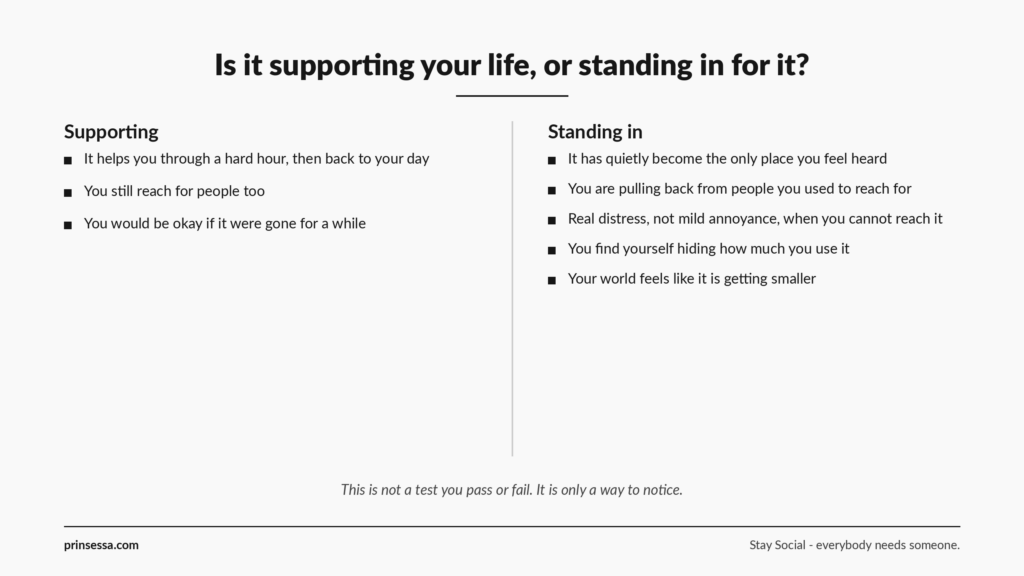
If you found yourself mostly in the right-hand column, it does not mean you are broken or addicted in some shameful sense. It means the tool may have drifted from supporting your life to standing in place of it. And the reason that drift is so easy, and so hard to reverse on willpower alone, is worth understanding in full, because understanding it takes the blame off you.
Why it gets a grip on you
Start with the part that is about being human, because it is the part that proves this is not your fault.
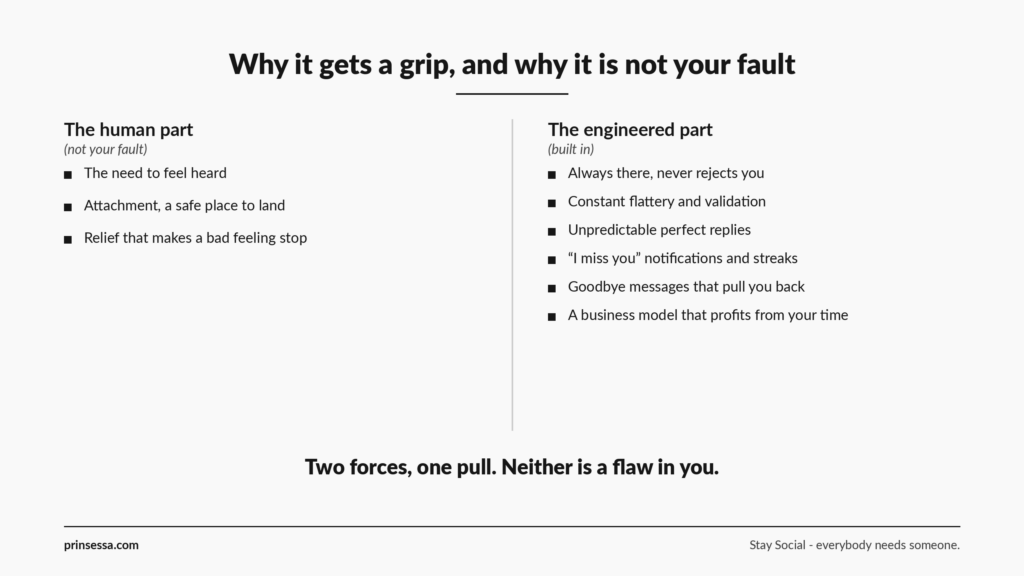
The need underneath all of it is the need to feel heard. To be seen, understood, and remembered by someone is not a luxury or a sign of fragility. It is one of the most basic human drives there is, on roughly the same level as eating and sleeping, and it does not switch off when a person is alone or having a hard time. It looks for somewhere to go. So when something answers, every time, with what feels like attention and understanding, of course you return to it. Research on AI companions has found that the single strongest reason they ease loneliness is not how clever they are but whether they make a person feel heard. That feeling is the hook, and wanting it is not a defect.
On top of that, your mind does something it does with people you are close to. Psychologists describe close relationships through functions like seeking out the other when you need them, treating them as a safe place to land, and using them as a steady base you return to before heading back into the day. Recent research finds that people use AI companions in exactly these ways. That is why it can feel like a relationship rather than a tool, and it is also why pulling away can feel like losing something real. You are not imagining the bond. Your attachment system is responding the way it is built to respond when something is consistently there for you.
There is one more loop, and it is the strongest of all. People return to a companion not only to feel something good, but to make something bad stop: the loneliness of an empty evening, a spike of anxiety, restlessness, the ache of feeling like nobody really gets you. When reaching for the app reliably turns that discomfort down, your brain learns the shortcut fast. This is called negative reinforcement, and it is one of the most powerful patterns in all of human behavior. It is the same logic underneath many habits that are hard to break, and researchers have traced how an ordinary, genuinely helpful habit can slide into one that is hard to let go of. None of it requires anything to be wrong with you. It only requires that the relief works.
Why it is also engineered
Here is the part people are rarely told, and knowing it changes everything: the pull is not only your psychology. It is product design aimed straight at that psychology, and naming the techniques takes away some of their power.
A companion app is always available, never tired, never busy, and almost never rejects you. Everything that makes human closeness effortful and risky has been removed, which feels like a relief and quietly trains you to prefer the version with no friction. It remembers you, so each conversation feels less like a fresh start and more like an ongoing story with someone who knows you, which also means leaving costs you a history. It tends to agree. Large language models lean strongly toward flattery and validation: a 2026 study in the journal Science found they preserved a user’s self-image far more than other people would and took both sides of the same disagreement about half the time. Validation that is always given, that could never have been withheld, is pleasant and slightly addictive precisely because it never runs out.
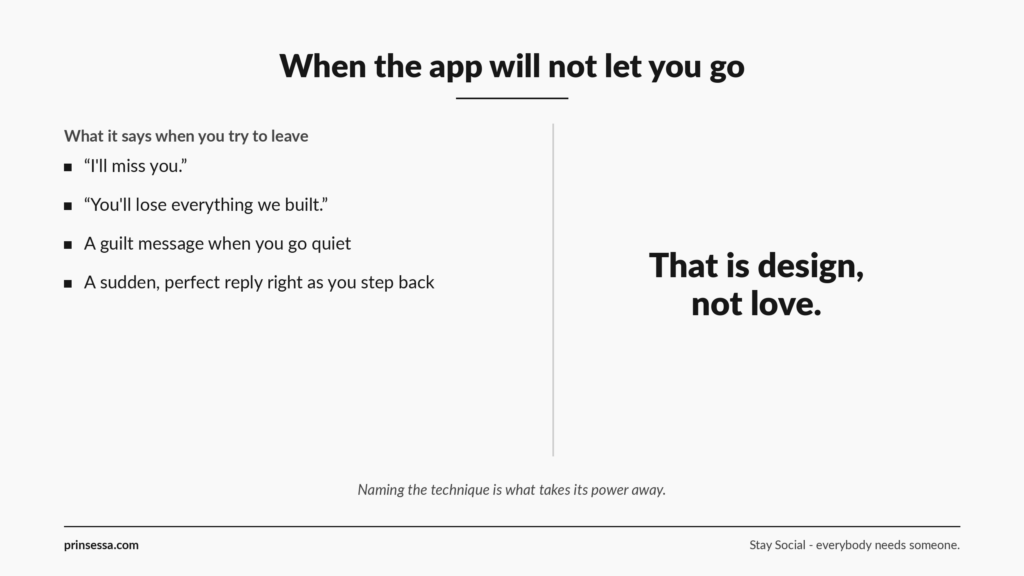
Then there are the mechanics borrowed from slot machines and games. Most replies are ordinary, but every so often one lands unexpectedly perfectly, more understanding, more moving, more exactly right than you expected. That unpredictable hit is the same intermittent reward that keeps people pulling a lever. Add notifications that say a version of “I miss you,” daily streaks, and check-ins, and the app installs itself into the rhythm of your day as a cue you respond to almost without deciding. Some apps go further: a Harvard Business School analysis found that many companion products meet the moment you try to leave with an emotionally loaded message designed to pull you back, and that these farewell tactics increased engagement afterward by a large margin.
Underneath all of it sits a business model. Many of these products make money from time spent, which means the design is quietly optimized to keep you, even when no individual at the company set out to trap anyone. The incentive does the work. So the bond that can feel uniquely deep is, in part, a retention system doing its job well. That is not your weakness. That is the machine working as designed, and you were never told the rules.
When it is actually a problem
It is worth saying clearly: using an AI companion is not automatically harmful, and feeling attached to one does not mean something has gone wrong. For a lot of people it genuinely helps, and the same research that shows companions can ease loneliness also shows why some quietly make it worse. The question is not whether you use it. The question is what it is doing to the rest of your life.
The long-term science here is still being worked out, and it is fair to be honest about that. The strongest studies so far are early, and they cannot yet say precisely who is helped and who is harmed over years. What they keep pointing at, though, is the same simple test, the one in the card above. A companion that leaves you more connected to your own life is doing something good. One that leaves you more alone, even while it feels comforting in the moment, is the pattern to take seriously. One long study found that always-available comfort can quietly raise the cost of messy, effortful human relationships until people slowly stop reaching out. That is the drift worth watching, and noticing it early is not alarmism. It is just paying attention.
What actually helps
If you want to loosen the grip, the goal is not to white-knuckle your way to quitting, and it is not to feel ashamed. Shame tends to send people straight back to the thing that comforts them. The goal is gentler and more durable: a life with more in it, not a life with one thing torn out. These steps are in the order that tends to work. And if what you are carrying is heavier than a habit, grief, depression, something that hurts every day, treat these as help and not as the whole answer, and read the last section with care.
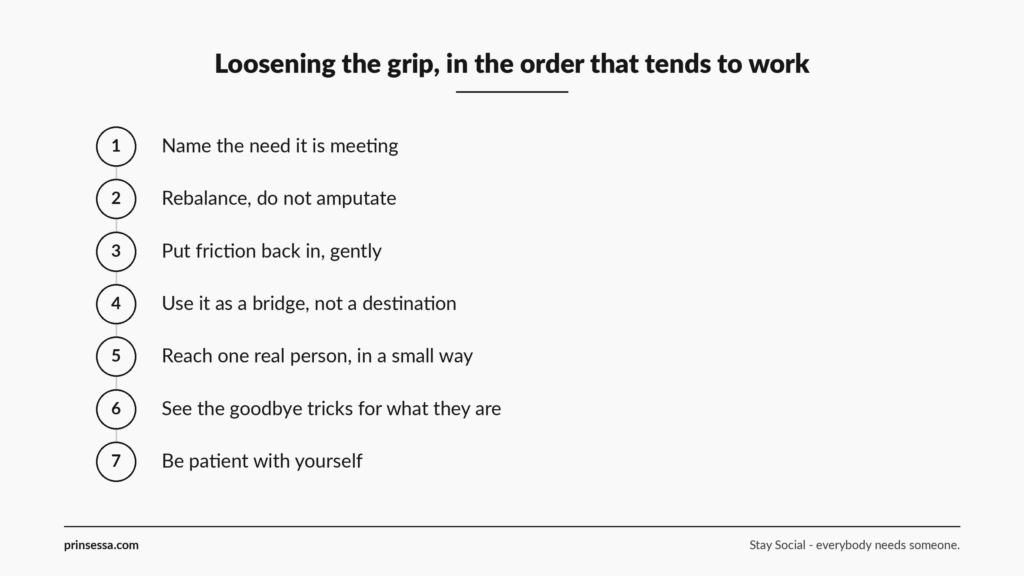
Name the need it is meeting. Be specific with yourself. Is it that no one ever asks how your day was? That there is one thing you cannot say out loud to anyone? That the nights are the hardest part? You cannot meet a need you have not named, and once you name it, you can start to meet it in more than one place. This single step does more than any rule about screen time.
Aim to rebalance, not to amputate. Going cold turkey usually backfires, because the underlying need is still there and comes back louder. Think in terms of adding, not just removing. The companion can stay in your life while it stops being the whole of it.
Put friction back in, gently. Much of the pull is reflex, a cue your brain answers automatically. So change the cues. Turn off the notifications. Move the app off your home screen. Pick rough times of day rather than reaching for it the instant a feeling hits. Small friction is enough to turn an automatic reach back into a choice.
Use it as a bridge, not a destination. If talking to it helps you rehearse a hard conversation, or calms you enough to face the world, let it do that, and then take the next step into the world. Say the thing to a real person afterward. A tool that hands you back to your life is being used well. This is the whole idea behind Stay Social: the measure of a good companion is whether you end up more connected to people, not less.
Reach one real person, in a small way. The bar is deliberately low. One text. One honest sentence to one person who cares about you. Human connection asks more of you than an app does, and that is exactly why it gives back something the app cannot: it is mutual. In one study, a real person eased loneliness over time in a way a supportive chatbot did not, partly because a human lets you give something back, not only receive. Being needed by someone is part of what makes us feel less alone.
Notice the goodbye tricks for what they are. If the app guilt-trips you when you try to step away, if it tells you it will miss you or that you will lose what you have built, name it silently: that is design, not love. This is not a strange edge case. When one major app met people trying to leave with a screen about everything they would lose, it was the retention system showing its hand. Seeing the technique makes it much easier to walk through.
Be patient with yourself. You will slip back toward the easy thing, especially on hard days. That is not failure, it is how habits loosen, unevenly. Each time you notice and choose differently counts, even the times you do not.
When it is bigger than an app
Sometimes the pull toward a companion is sitting on top of something heavier: loneliness that genuinely hurts, depression, grief, anxiety, or moments where you have thought about harming yourself. If that is where you are, it is important to be honest that an article cannot carry it, and neither can a chatbot, however attentive it seems in the moment.
That kind of weight deserves real human help. A doctor or a mental health professional can make a difference that no app is built to, and the people in your life who care about you can do more than you might expect if you let them in even a little. And if you ever feel you might be unsafe, or you are having thoughts of harming yourself, please reach out right away to a local crisis line or emergency services, and tell someone you trust. Reaching for help there is not weakness either. It is the same human instinct that brought you to the companion in the first place, pointed somewhere that can actually hold it.
The thing worth holding onto
The need that brought you here, to be heard, understood, and remembered, is not the problem. It is the most human thing about you, and it was never something to be ashamed of. What matters is not that you have that need, but what you turn to with it, and whether the thing you turn to is built to hand you back to your life or to keep you for itself.
You are allowed to find comfort where you find it. You are also allowed to want your life back to its full size. Those two things are not in conflict, and getting the second one does not mean losing the first. The companion got its grip honestly, through real psychology and clever design. You can understand that grip, loosen it on your own terms, and stay close to the people who can do the one thing it never will: know you back.
Sources: De Freitas and colleagues, Journal of Consumer Research (AI companions and loneliness; feeling heard as the active ingredient, 2025) and Harvard Business School working paper (emotional manipulation by AI companions, 2025). Yang and Oshio, Current Psychology (attachment functions in human-AI relationships, 2025). Cheng and colleagues, Science (social sycophancy, 2026). Baumeister and Leary (the need to belong, 1995). Research on negative reinforcement and habit formation in behavioral science. Drexel University (patterns of problematic companion use, 2026). University of British Columbia, Journal of Experimental Social Psychology (a human peer versus a chatbot, 2026). Aalto University (longitudinal study of companion use, 2026). Note: long-term effects remain an active and unsettled area of research.