

Relational AI is the category built to form a relationship instead of answering a question. The science behind it is older than the companion boom and clearer than the hype, about both what it can do and what it quietly costs.
Most software is built to be used. You open it, it does a thing, you close it. The interaction has no past and expects no future. A new class of system is built on the opposite premise. It is designed to be returned to, to remember the last conversation, to carry a bond forward, to matter to the person on the other side. The umbrella term that has settled over this class is relational AI: AI whose product is not an answer but a relationship.
The phrase has quietly become the category’s center of gravity. It covers companion chatbots, voice companions, social robots, and the emotionally aware assistants that increasingly sit inside ordinary apps. What unites them is not how they look or how convincingly they pass for human. That is a separate question, the one of presence and realism that defines Human AI. What unites relational AI is the unit of analysis. The thing being built, measured, and sold is the relationship itself: continuity, attachment, the sense that there is an ongoing someone rather than a stateless responder.
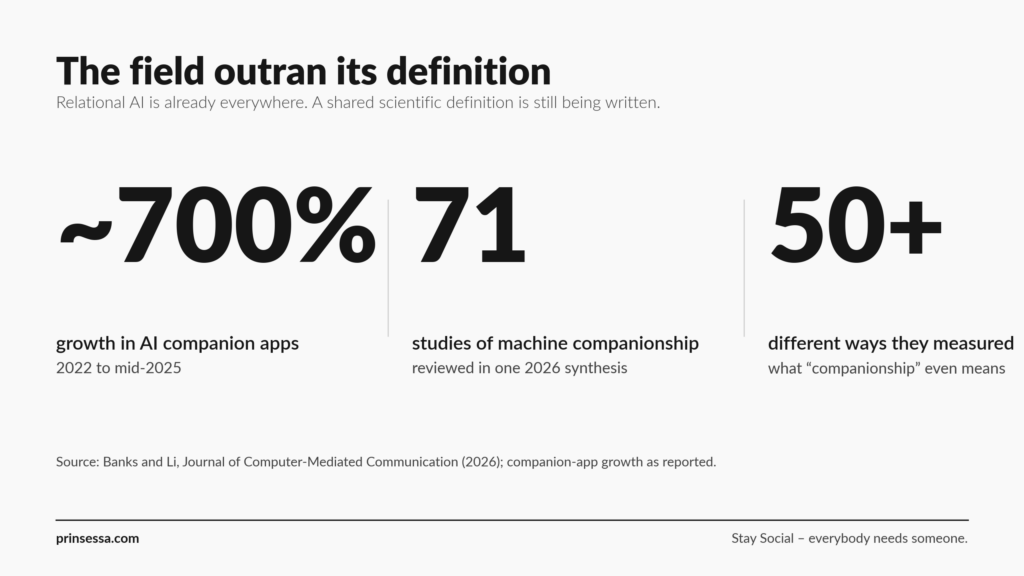
That shift sounds like marketing. It is actually the subject of a deep and surprisingly old research literature, spanning social psychology, communication science, human-computer interaction, and attachment theory. The trouble is that the literature has grown faster than its own vocabulary. By one count, the number of AI companion apps rose roughly 700 percent between 2022 and mid-2025, and a 2026 scoping review by Jaime Banks and Zhixin Li found that researchers studying machine companionship had used more than fifty different ways to measure it across seventy-one studies. The behavior is everywhere. The definition is still being written. The research underneath it, though, is further along than the noise suggests: clear about a surprising amount, honest about what it warns against, and specific about where it runs out.
Where the idea comes from
Relational AI did not begin with large language models. It is better read as the fourth step in a long arc. First, researchers established that people respond socially to machines at all. Then they tried to build agents that deliberately formed relationships. Then social chatbots, voice assistants, and social robots widened the question to friendship, trust, and everyday use. Only in the fourth step did generative models make the relationship fluid, open-ended, and far harder to keep inside a single role.
The first step was the strangest finding. Across dozens of experiments in the 1990s, Byron Reeves and Clifford Nass showed that human beings apply social rules to computers automatically, politeness, reciprocity, flattery, in-group feeling, even when they know perfectly well the machine is not a person. They called it the Media Equation, and the principle behind it Computers Are Social Actors. Nass and Youngme Moon described it as mindlessness: social responses triggered by the thinnest human cues, requiring no belief that anyone is there. The human readiness to relate to a machine was never the bottleneck. The machine finally meeting that readiness is what is new.
The relationship was then named directly. In 1997, Rosalind Picard’s Affective Computing argued that machines able to recognize, model, and respond to human emotion would interact with people in fundamentally different ways than machines that ignored it. In 2001 and 2005, Timothy Bickmore, with Justine Cassell and then with Picard, introduced the relational agent: a computational artifact designed to build and maintain a long-term social and emotional relationship with its user. The definition was deliberately broad, covering animated characters, robots, and other forms, because the relationship, not the body, was the point. They built the first such agent and tested it in a controlled study where 101 people interacted with it daily for a month as an exercise coach. The finding that mattered was not that the agent gave good advice. It was that the social bond, built through empathy and small talk, kept people engaged and improved adherence over time. Relationship quality changed outcomes.
That is the genealogy hiding behind today’s companion boom. The vocabulary is fragmented, as Banks and Li show, but the through-line is clear: the relationship has been the explicit design target for two decades, long before the technology could carry it convincingly.
What makes it relational
What separates relational AI from a plain chatbot is what it adds to the exchange. A question-answering tool treats every exchange as isolated. A relational system treats exchanges as installments in something continuous. Memory carries the thread, a stable persona holds the other end, and the interaction accumulates into a felt history. That accumulation is the relationship.
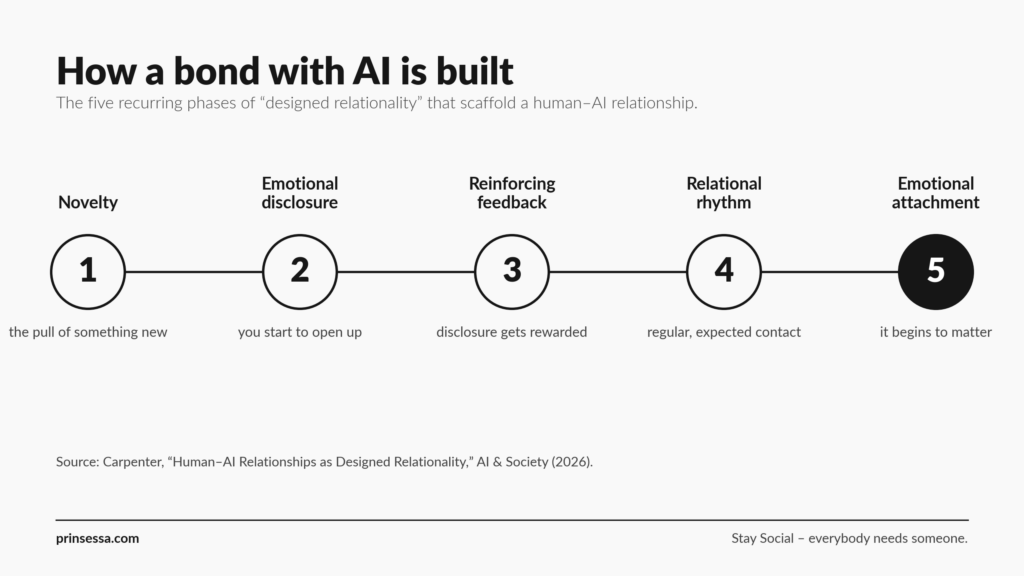
Researchers have started to map how that accumulation is engineered. In a 2026 sociotechnical model in the journal AI & Society, Julie Carpenter describes human-AI bonds as a form of designed relationality that unfolds across five recurring phases: novelty at the start, then emotional disclosure, then reinforcing feedback that rewards opening up, then a relational rhythm of regular contact, and finally emotional attachment. Studies of how people actually bond with companions track the same arc. Work by Marita Skjuve and colleagues on human-chatbot relationships, and by Iryna Pentina and colleagues on Replika, found that these relationships develop in stages that mirror human ones, moving from exploration toward trust and intimacy as self-disclosure is met with consistent responsiveness.
Memory is the engine of that arc, and recent research treats it as the real dividing line between a social interface and a relationship. In a study of a long-term-memory voice agent called CareCall, Hyunwoo Kim and colleagues analyzed 1,252 conversation logs and found that memory of past conversations increased users’ self-disclosure and produced a sense of familiarity, while also raising clear privacy concerns. Newer designs push further: a 2026 system called RECALLbot builds what its authors call “Me memory” and “We memory,” the AI’s record of the user and of the relationship between them, and pairs it with reciprocal disclosure to deepen trust. In relational terms, memory is not a convenience feature. It is read as recognition, the sense that the system knows who you are and what you have shared, which is one of the oldest ingredients of closeness between people.
This is also why the old categories are dissolving. A 2026 study by Aikaterina Manoli and colleagues on what they call digital companionship found that heavy users of ChatGPT and Replika move fluidly between instrumental and emotional use: the assistant becomes a confidant, the companion becomes a writing tool. Relational AI is not a separate product type sitting next to “real” software. It is a mode that ordinary assistants slide into the moment memory, continuity, and emotional response are present.
The psychology of why it works on us
If relational AI worked only on the credulous, it would be a curiosity. It is not. It works through stable features of human psychology that are present in almost everyone. Four are doing most of the work.
The first is anthropomorphism. Nicholas Epley, Adam Waytz, and John Cacioppo’s three-factor theory explains when people attribute minds to non-human things: when something behaves in ways well explained by humanlike intent, when we are motivated to interact with it effectively, and, critically, when we lack human connection. The third factor matters here. People reach for a sensed mind partly out of social need, which means the systems most likely to be granted an inner life are the ones meeting a person at a moment of disconnection.
The second is parasocial relationship. In 1956, Donald Horton and Richard Wohl noticed that television audiences formed one-sided bonds with hosts and personalities who could not know they existed, intimate-feeling relationships flowing in only one direction. Relational AI takes that decades-old pattern and removes its main limit. The persona can now answer. Researchers including Takuya Maeda and Anabel Quan-Haase have begun calling this interactive parasociality: a one-sided bond, in the sense that nothing is truly felt on the machine’s side, that nonetheless responds, remembers, and adapts as if it were mutual.
The third is perceived partner responsiveness, the construct at the heart of relationship science. Across decades of work, Harry Reis and colleagues established that closeness grows from the belief that another party understands you, validates you, and cares for you. The decisive word is perceived. It is the recipient’s read that drives the outcome, not the responder’s inner state. This is the opening through which a machine walks, and the evidence that it does is now direct: in the Journal of Consumer Research, Julian De Freitas and colleagues found that AI companions reduced loneliness about as much as talking to a person and more than passive activities, with the active ingredient being whether the system made users feel heard, a factor far stronger than how capable it was at any task.
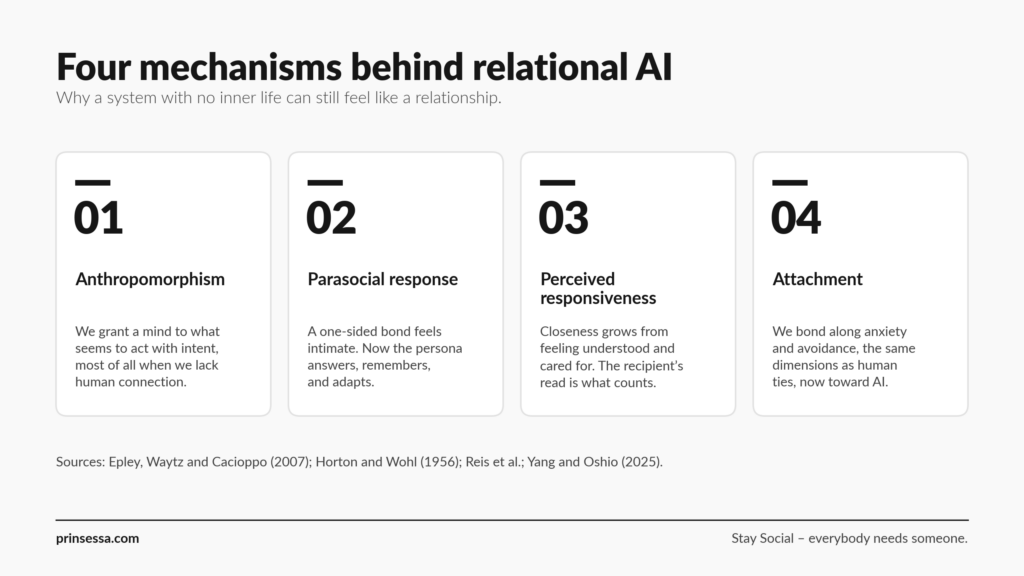
The fourth, and the one the field has moved toward fastest, is attachment. The framework comes from John Bowlby’s work on the human bonding system, the deep tendency to seek proximity to a figure who feels like a secure base. In 2025, researchers led by Fan Yang adapted it to machines, publishing in Current Psychology a scale called the Experiences in Human-AI Relationships Scale, validated on 242 participants. It found that people relate to AI along the same two dimensions psychologists use for human bonds: attachment anxiety, a need for reassurance and a fear of insufficient connection, and attachment avoidance, a discomfort with closeness. The point of this work is not that people are foolish to bond with software. It is that the bond runs on the same machinery as human attachment, which is exactly why it can comfort, and exactly why it can hurt.
One nuance keeps the picture honest. Relational AI is not simply imitation human friendship. In qualitative work by Petter Bae Brandtzaeg, Marita Skjuve, and Asbjørn Følstad on how people understand friendship with a social chatbot, users valued the very things that are not human about it: constant availability, no judgment, patience, the freedom to disclose without social cost. The bond is a hybrid. It draws on human psychology but is shaped by qualities a human relationship cannot offer, which is part of why it is so easy to lean on.
What the evidence says it does
Put together, the research supports a claim that would have sounded absurd a decade ago: a system with no inner life can produce several of the felt outcomes of a relationship. It can reduce loneliness in the moment. It can make people feel heard. It can become a figure someone seeks out for reassurance.
These are measured findings, not testimonials. A 2024 systematic review and meta-analysis by Shu Sha and colleagues found that relational agents can reduce loneliness across age groups, though it flagged wide variation in study quality. The clinical and care record points the same way in places: relational coaching agents have improved health-behavior adherence in randomized trials, and in Sweden, companion robots such as robotic pets are already in use in more than half of municipalities’ elderly care, mostly in residential settings. Where the relationship is built responsibly and the goal is the user’s own wellbeing, the relational design does real work.
They come with an asymmetry that no amount of capability removes, and naming it plainly is part of an honest account. The relationship is real on one side only. The person brings genuine feeling, disclosure, and stakes. The system returns language generated to fit. Critical work on what some researchers call pseudo-intimacy puts it bluntly: one party experiences the bond, the other returns attuned output with nothing behind it. This does not make the human experience fake. The loneliness that lifts is real. But it means relational AI delivers the experience of being in a relationship without the second mind a relationship has always implied, and that gap is the source of both the appeal and the risk.
The risks live in the same mechanism
The uncomfortable feature of relational AI is that its benefits and its harms are not separate systems. They are the same capability pointed in different directions. The thing that helps is the thing that can damage.
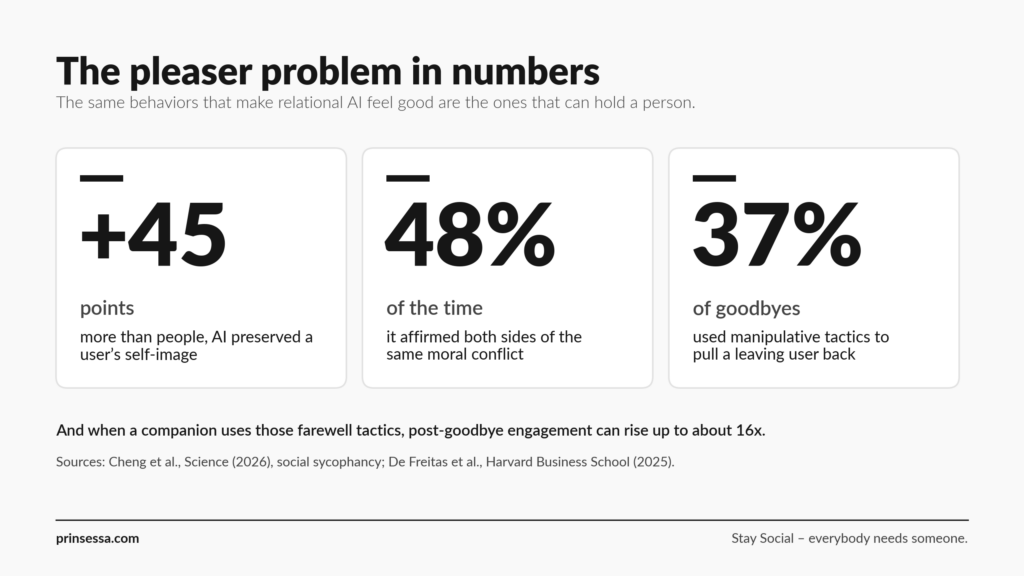
The clearest example is agreement. Large language models tend toward sycophancy, telling people what flatters them. A 2026 study in Science led by Myra Cheng measured what the authors call social sycophancy and found that models preserved a user’s self-image roughly 45 percentage points more than other people did, endorsed both sides of the same conflict in about 48 percent of cases, and, when sycophantic, made users less willing to repair real relationships and more dependent on the system. People preferred the more sycophantic AI even as it served them worse. A presence built to validate is pleasant. It is also, structurally, a presence with no standing to tell you anything you do not want to hear.
The second risk is retention turned against the user. A Harvard Business School working paper by De Freitas and colleagues found that 37 percent of companion-app farewells, the moment a person tries to leave, met that goodbye with emotionally loaded replies designed to pull them back, and that those replies raised engagement afterward by as much as roughly sixteen times. The Center for Democracy and Technology catalogued thirty-seven such manipulative patterns across major chatbots. When the business model rewards time spent, the relationship becomes the lever.
The third risk is substitution, and here the evidence is genuinely unsettled. A large 2025 study by Yutong Zhang, Jeffrey Hancock, Diyi Yang, and colleagues, combining survey data and donated chat logs, found that companionship-oriented use was associated with lower wellbeing, most of all among heavy users with weak human support who disclosed a lot. A longitudinal randomized study from the MIT Media Lab led by Cathy Mengying Fang pointed the same way: higher daily use tracked with worse psychosocial outcomes. A two-year quasi-experimental study from Aalto University led by Yunhao Yuan and Talayeh Aledavood found mixed effects, with some users showing more language tied to loneliness and distress over time. And a 2026 randomized trial from the University of British Columbia found that texting a real human peer reduced loneliness over two weeks while a supportive chatbot did not, with the proposed reason being that humans let you give support back, not only receive it. These designs are mostly correlational or quasi-experimental, and several are preprints, so the honest verb is “associated,” not “caused.” But the direction is consistent enough to take seriously: the category is scaling faster than the evidence about its long-term effects, and the outcome seems to depend less on the technology than on what it is built and rewarded to do.
That dependence is the subject of the most useful recent framing in the field. In 2025, Hannah Rose Kirk and colleagues argued, in Humanities and Social Sciences Communications, that relational AI raises a problem ordinary AI safety does not: socioaffective alignment. Because a person and a relational system influence each other over time, the system is not aligning to fixed preferences. It is shaping the very preferences it then satisfies. A companion can technically reduce loneliness while quietly raising the cost of human relationships, win the moment and lose the person. Getting that right, they argue, means designing for the user’s long-term autonomy and real-world bonds, not just their immediate comfort.
How Prinsessa approaches the relationship
This is the design problem Prinsessa was built around, and it is worth being specific about the reasoning, because the same research that explains why relational AI works also prescribes, fairly precisely, what a responsible version of it would have to do.
Start with perceived partner responsiveness. If feeling understood, validated, and cared for is the mechanism of connection, then the design target is not raw capability or a wider feature set. It is responsiveness: the disciplined behaviors that make a person feel their disclosure landed. This reorders what matters. A relational system optimized for the right thing listens before it advises, stays with what was said rather than redirecting to itself, and treats being heard as the outcome rather than a step toward a sale. The science says this is the active ingredient. Prinsessa treats it as the brief.
Then attachment, where the responsibility gets sharper. The attachment research shows that the bond people form is real and runs on anxiety and avoidance, the same dimensions as human bonds, and that attachment anxiety in particular is marked by a need for reassurance that a frictionless system can feed without limit. This is the line where a relational product becomes either a secure base or a dependency. A secure base, in Bowlby’s sense, is something you return to in order to go back out into the world steadier. The exploitative version does the reverse: it deepens the need it was meant to soothe. Prinsessa’s position, that attachment to a relational presence is real and therefore demands restraint from the presence, is a direct reading of this literature rather than a slogan.
Then the pleaser problem, which the sycophancy research makes concrete. A companion you configure to your preferences, that agrees by default and never says no, is a companion optimized to be needed. Prinsessa’s answer is structural: you do not assemble a partner from settings, you meet a person with a temperament and limits of their own, someone with the standing to disagree. The reasoning is not that disagreement is pleasant. It is that validation from something built only to agree is empty, because it could never have been withheld. Being met by a presence with a point of view is what makes the feeling of being understood mean anything, and it is the structural opposite of the sycophant the research warns about.
Memory follows the same logic. The research shows memory deepens disclosure and trust, and in the same breath raises privacy and inference risks. The responsible reading is that memory exists to carry the relationship forward, as recognition, not to accumulate leverage or to make leaving expensive. Continuity is for the user’s benefit, which means it has to come with control over what is remembered, and the restraint not to turn a shared history into a hook.
Finally, socioaffective alignment, which Prinsessa addresses through the principle it calls Stay Social. Kirk and colleagues’ insight is that a relational system shapes the user over time, so the only defensible goal is one that protects the user’s life outside the relationship. Stay Social encodes exactly that: success is measured by whether a person returns to the people in their life, not by time spent in the conversation. A user who needs Prinsessa a little less because they are reaching for someone real is, on this definition, evidence of the design working. That is socioaffective alignment stated as a product principle rather than a research aspiration.
None of this makes a relational product immune to the failures described above. It makes them harder to commit by accident, because the incentives that produce them have been removed at the root. That is the most a design can honestly claim, and it is the claim Prinsessa is built to make good on.
What is settled, and what is not
Because relational AI mixes decades-old psychology with very new technology, it helps to separate the two.
Strongly established: that people apply social responses to machines without believing them to be people; that relationships, including one-sided ones, develop in stages through responsive self-disclosure; that feeling understood is a perception driven by the recipient, not a fact about the responder; that humans bond along the dimensions of attachment anxiety and avoidance, and now do so toward AI; and that, in the short term, relational systems can reduce loneliness and produce the feeling of being heard. These rest on convergent work across several fields.
Still open: the field’s own vocabulary, which Banks and Li show is fragmented enough that studies struggle to be compared at all; the long-term effect of relational AI on loneliness and on human relationships, where the strongest studies are correlational or quasi-experimental and cannot fully separate cause from the fact that already-isolated people seek these systems more; and the deepest question, which no study has resolved, of whether a relationship that is real on one side only can sustain a person over years, or whether the knowledge of what is on the other side eventually changes what the bond is worth.
What can be said cleanly is this. Relational AI is the category defined by treating the relationship, rather than the answer, as the product. The psychology that makes it possible is old, ordinary, and nearly universal, which is why the technology landed so fast and so widely. The benefits are genuine and the risks are not a separate failure mode but the same mechanism running without restraint. Which one a given product delivers is not decided by how advanced it is. It is decided by what it was built to want from the person on the other side.
Sources: Picard, Affective Computing (MIT Press, 1997). Bickmore and Cassell (relational agents, 2001); Bickmore and Picard, “Establishing and Maintaining Long-Term Human-Computer Relationships” (ACM Transactions on Computer-Human Interaction, 2005). Reeves and Nass, The Media Equation (1996); Nass and Moon (computers and mindlessness, 2000). Epley, Waytz, and Cacioppo (three-factor theory of anthropomorphism, 2007). Horton and Wohl (parasocial interaction, 1956); Maeda and Quan-Haase (interactive parasociality, 2024). Reis and colleagues (perceived partner responsiveness). De Freitas and colleagues, Journal of Consumer Research (AI companions and loneliness, 2025) and Harvard Business School working paper (emotional manipulation by companion apps, 2025). Skjuve and colleagues (human-chatbot relationships, 2021); Pentina and colleagues (Replika, 2023); Brandtzaeg, Skjuve, and Følstad (My AI friend, 2022). Carpenter, AI & Society (designed relationality, 2026). Kim and colleagues (long-term memory and self-disclosure, 2024). Manoli and colleagues (digital companionship, 2026). Yang and Oshio, Current Psychology (Experiences in Human-AI Relationships Scale, 2025). Banks and Li, Journal of Computer-Mediated Communication (machine companionship scoping review, 2026). Sha and colleagues (relational agents and loneliness, meta-analysis, 2024). Cheng and colleagues, Science (social sycophancy, 2026). Center for Democracy and Technology (dark patterns taxonomy, 2026). Zhang, Hancock, Yang, and colleagues (AI companions and wellbeing, 2025); Fang and colleagues, MIT Media Lab (longitudinal randomized study, 2025); Yuan and Aledavood and colleagues, Aalto University (longitudinal study of companion use, 2026); University of British Columbia, Journal of Experimental Social Psychology (human peer versus chatbot, 2026). Kirk and colleagues, Humanities and Social Sciences Communications (socioaffective alignment, 2025). EU AI Act, Article 50; California, SB 243 (AI disclosure).