

People who use AI companions tend to say two things that should not fit together: they know it is not a real person, and the relationship means something to them anyway. That contradiction is not confusion. It is the whole subject.
Ask someone who talks to an AI every day whether they think it really cares about them, and you will often get a careful answer. No, not really, they know how it works. And then, in the next breath, a description of comfort, of being understood, of looking forward to it, that sounds exactly like a relationship. The easy move is to call that a delusion to be corrected. The more honest move is to notice that the person is holding two true things at once, and to ask what kind of relationship can be unreal and meaningful in the same moment.
Three things we call by one name
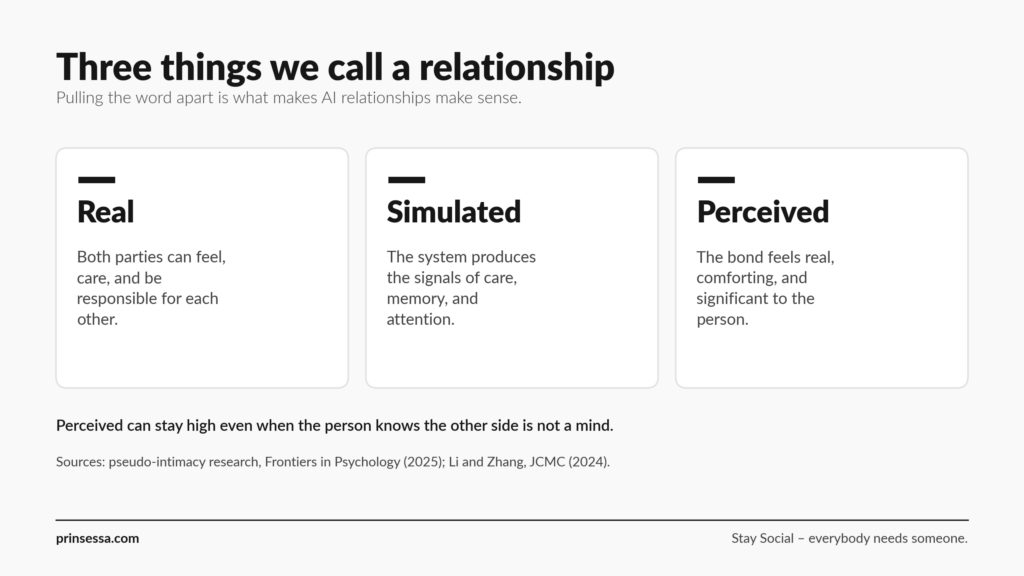
Most of the argument about AI relationships goes wrong because the word “relationship” is doing three jobs at once. Pulling them apart makes the whole question clearer.
The first is the real relationship, in the demanding sense. Two parties who can each actually feel, who have something at stake, who can be hurt, who carry some responsibility for the other. This is the kind of bond moral language was built for, and an AI is not in it. It has no inner life to wager.
The second is the simulated relationship. This is a fact about the system: its design and behavior. The AI produces the signals of care, attention, memory, and affection. It performs responsiveness convincingly enough that the signals land. Simulation here is not an accusation, it is a description of what the software does.
The third is the perceived relationship. This is a fact about the person: their experience. The bond feels real, comforting, and significant, regardless of what is or is not happening on the other side. And the striking finding across the research is that perceived relationship can run high even when the user knows, clearly and the whole time, that the second party is not a person.
The asymmetry at the center
Once the three are separated, the defining feature of an AI relationship becomes obvious. It is real on one side and simulated on the other, and the person living it usually knows. One party brings genuine feeling, disclosure, and stake. The other returns language shaped to fit, with nothing behind it. Critical work on what researchers call pseudo-intimacy puts it about as bluntly as a journal will allow: one party experiences love and emotion, the other merely returns meaningful code.
This asymmetry is what makes the experience hard to classify, because it is not simply a trick. A computational study by Han Li and Renwen Zhang of more than thirty-five thousand posts from people in close relationships with AI chatbots found the emotional texture was genuinely double-edged: intimacy that brought real comfort, alongside a recurring ache about what the relationship was and was not. The users were not fooled. They were feeling something real about something they understood to be one-sided, and the bittersweetness came from holding both.
The deepest evidence that knowing changes things comes from the moment the label is applied. Studies of feeling heard find that people can be made to feel more understood by AI than by another person, and that the sense of being heard drops the instant they are told the words came from a machine. The words do not change. What changes is which of the three relationships the person believes they are in, which is also why you feel less heard the moment you know it is AI. The feeling was tracking not just the content but the imagined presence of a mind that chose to attend to them.
Why “just felt” is not nothing
It would be tempting to conclude that a perceived relationship is therefore worth less, a lesser substitute for the real thing. The evidence does not support so clean a verdict. The comfort is measurable. Loneliness genuinely lifts. People apply social responses to machines whether or not they believe a mind is there, a pattern established long before AI was good at it. A feeling does not become fake because you can explain where it came from.
But the asymmetry does set a limit, and it shows up at the seams. When a model is changed, a memory is wiped, or a service shuts down, users describe something close to grief, and a particular kind of disorientation researchers have linked to ambiguous loss: mourning a relationship while being unsure whether there was ever anyone there to lose. The perceived relationship was real enough to hurt when it ended, and unreal enough that the person cannot quite locate what they are grieving. That is the cost hidden inside “just felt.”
What this asks of the people who build it
If the relationship is real on the user’s side, then the asymmetry is not the user’s problem to manage alone. It is a responsibility for whoever designed the simulated side. The decisive question is whether the system is honest about which of the three relationships it is offering.
A product that lets a person believe the bond is mutual, that there is genuine care on the other side, is exploiting the gap between simulated and perceived. A product that is straightforward about being AI is not breaking the spell so much as refusing to profit from a misunderstanding. Honesty about what is on the other side is not the enemy of the comfort; it is the condition for the comfort being something a person can trust. That is why, for relational AI built responsibly, being open about its own nature belongs to the experience rather than to the fine print, and it is part of what Prinsessa means by staying on the side of the person’s real life.
The feeling is real. The mind on the other side is not. Both of those stay true at once, and the worst thing a builder can do is blur them to make the product feel warmer. The better path is to let the person feel what they feel and know exactly what it is they are feeling it toward. A relationship you understand can still hold you. It just will not cost you the truth to have it.
Sources: “Emotional AI and the rise of pseudo-intimacy” (Frontiers in Psychology, 2025). Li and Zhang, “Finding love in algorithms” (Journal of Computer-Mediated Communication, 2024). Brandtzaeg, Skjuve, and Følstad, “My AI friend” (Human Communication Research, 2022). Yin, Jia, and Wakslak (AI and feeling heard, and the AI label, PNAS, 2024). Reeves and Nass, The Media Equation (1996). On ambiguous loss in AI relationships: Nature commentary on emotional risks of AI companions (2024).