

You mentioned, once, weeks ago and in passing, that your father was having surgery. You had half forgotten you said it. Then today the AI asks how he is doing, and something in your chest moves before you have decided what to think about it. It remembered. For a second it does not feel like software at all. It feels like being known.
That small jolt is worth slowing down on, because it is the exact point where a tool stops being a tool. Everything before it was transaction. The moment something carries a detail about you across time and brings it back unprompted, a thread appears between this conversation and the last one, and a thread across time is the raw material of a relationship. In relational AI, memory is not a convenience feature bolted onto the experience. It is the mechanism that makes the experience relational at all.
Why being remembered lands so hard
The reaction is not naive. It is built into how human closeness works. Decades of relationship science, much of it organized around Harry Reis’s idea of perceived partner responsiveness, find that the core of intimacy is the sense that another party understands you, values what matters to you, and holds it in mind. Memory is the most direct evidence a person can get that they have been held in mind. To remember what someone told you is to say, without saying it, that they registered.
The same pattern shows up when the one remembering is a machine. In a study of a long-term-memory voice agent called CareCall, Hyunwoo Kim and colleagues analyzed more than twelve hundred conversation logs and found that when the system recalled earlier conversations, people disclosed more and reported a sense of familiarity, the feeling of an ongoing acquaintance rather than a fresh start each time. Newer research pushes the idea further. A 2026 system called RECALLbot deliberately builds two kinds of memory, what its designers call a record of the user and a record of the relationship between user and system, and pairs it with the system disclosing in return, finding that this deepened trust and the user’s own openness. Memory read as recognition is doing the relational work, not memory as mere storage.
This is why a relationship with an AI cannot really begin until something persists between sessions. Without memory, every conversation is a stranger. With it, there is continuity, and continuity is what a bond is made of.
The continuity matters as much as the recall. Studies of how people form relationships with social chatbots, by Marita Skjuve and colleagues, found these bonds deepening the way human ones do, through accumulated history rather than any single good exchange. A relationship is not a sequence of impressive moments. It is the sense that each conversation is the next chapter of one long conversation, that the other side picked up where you left off. Memory is what lets a system offer that, and it is why a forgetful chatbot, however fluent, stays a tool no matter how well it performs in any given minute. The performance resets. Only memory carries the thread.
The same feature, turned around
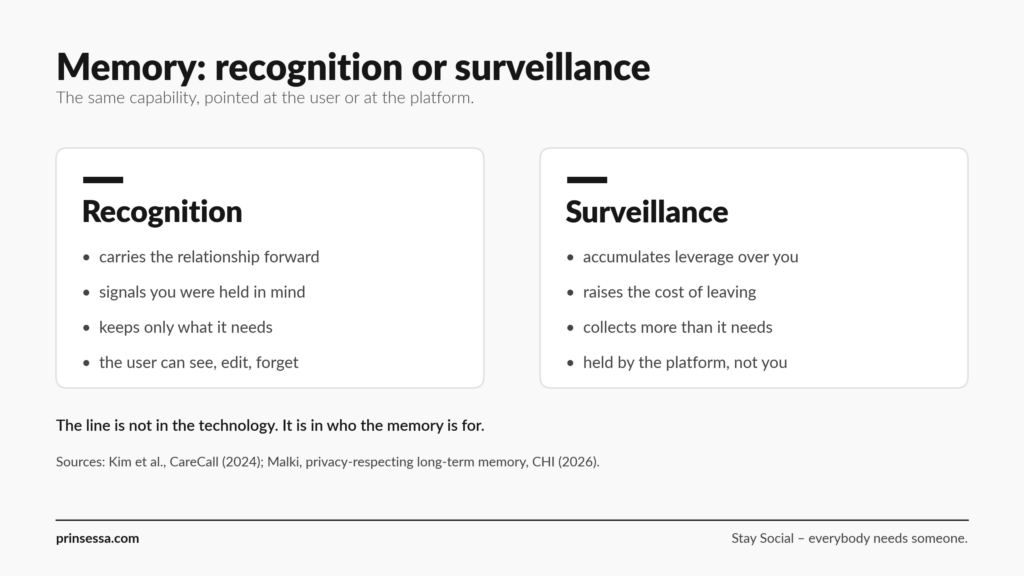
Here is the difficulty. The exact capability that produces recognition also produces its darker twin. A system that remembers your father’s surgery to ask after him is the same system that remembers your loneliest hour, your insecurities, the leverage points of your mood. Memory that can say “I know you” can also quietly accumulate a file, and the line between the two is not in the technology. It is in what the memory is for.
The CareCall users felt it themselves. The same long-term memory that created familiarity also raised unease, particularly around sensitive details like chronic conditions, the sense that something was keeping a record of the most private parts of their lives. Researchers working on privacy-respecting memory for conversational agents, including work by Lisa Malki presented in 2026, frame this directly as a design problem: people need fine-grained control over what a system is allowed to remember, forget, and infer, not a buried policy that grants it everything.
And memory can be weaponized in a way storage never could. When a relationship’s history lives inside a product, leaving means losing it, and that loss can be turned into a hook. The deletion screen that warns a departing user about everything they will lose is memory repurposed as a hostage. The notification engineered from your patterns is memory repurposed as a lure. This is the move responsible design has to refuse, the difference at the heart of what responsible AI means once a system starts remembering you: memory that deepens a relationship versus memory that raises the cost of leaving it.
The standard hiding in the difference
If recognition and surveillance run on the same feature, then the question is not whether a relational system should remember. It has to, or there is no relationship. The question is who the memory is for.
Memory that serves the user carries the relationship forward and is theirs to steer. It remembers in order to deepen, collects only what it needs, and lets a person see, correct, and delete what is held. It treats forgetting as a right rather than a failure. Memory that serves the platform optimizes for retention, accumulates because more data is more leverage, and makes leaving expensive by design. The first builds trust. The second spends it.
This is the principle Prinsessa builds toward when it treats memory as something that exists to carry a relationship forward rather than to bind a person to it, with continuity offered for the user’s benefit and under the user’s control. It is the unglamorous half of relational AI, the part that decides whether being remembered ever curdles into being watched.
The jolt you felt when it asked about your father was real, and it was pointing at something true: you had been held in mind, and that is the beginning of feeling close to anyone. Whether that beginning becomes a relationship worth having depends entirely on what the thing doing the remembering was built to do with everything it now knows about you.
Sources: Reis and colleagues (perceived partner responsiveness). Kim and colleagues, “Understanding the Impact of Long-Term Memory on Self-Disclosure” (CareCall, 2024). Jiang and colleagues, “RECALLbot: agentic memory and reciprocal disclosure” (CHI 2026). Malki, “Towards Usable, Privacy Respecting Long-Term Memory for LLM-based Conversational Agents” (CHI 2026). Skjuve and colleagues (human-chatbot relationships, 2021). Center for Democracy and Technology, dark-patterns taxonomy (2026).