
You opened it to fix an email. It fixed the email. Then, because it was right there and the day had been long, you mentioned that the email was for a job you were not sure you wanted, and it asked a question back, and twenty minutes later you were not editing anything at all. Somewhere in that exchange the tool became something else, and you did not notice the moment it happened.
That slippage is no longer an anecdote. It is one of the more important findings about how people actually use AI, and it quietly dismantles a distinction the whole industry has been organized around: the idea that there are productivity tools over here and companions over there, and that you know which one you are using.
Two categories that were never that separate
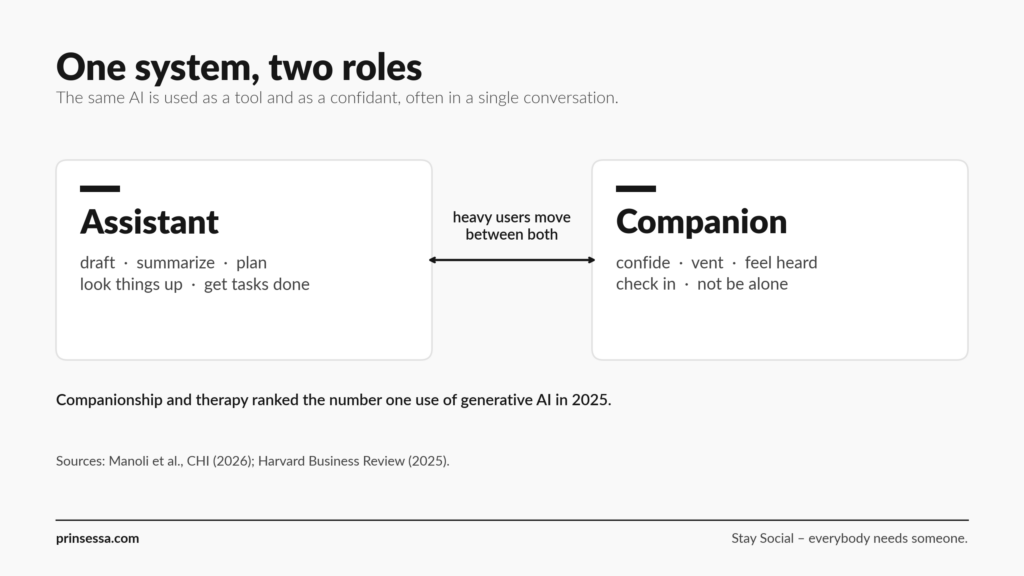
The market tells a tidy story. Assistants are for tasks. You use ChatGPT to draft, summarize, and plan, the way you use a spreadsheet. Companions are for feelings. You talk to a companion app for company, comfort, or romance, and everyone understands that is a different kind of thing. The two are sold separately, studied separately, and regulated, where they are regulated at all, as if they were different species.
The trouble is that people do not stay on their side of the line. In a 2026 study of what they call digital companionship, Aikaterina Manoli and colleagues looked at how heavily engaged users actually use ChatGPT and a dedicated companion app, and found the supposed categories collapsing into each other. The assistant became a confidant people brought their worries to. The companion became a tool people used to write and think. The same person moved fluidly between instrumental and emotional use, often inside a single conversation, treating one system as many things depending on the hour and the mood.
The broader usage data points the same way. A widely cited Harvard Business Review analysis of how people were really using generative AI in 2025 placed companionship and therapy at the very top of the list, ahead of the productivity tasks the tools were ostensibly built for. The single most common thing people do with general-purpose AI turns out to be something the product page never advertised.
Why a tool becomes a someone
This is not a story about confused users. It is a predictable result of two things meeting.
The first is decades old. Byron Reeves and Clifford Nass spent the 1990s showing that people apply social rules to computers automatically, politeness, reciprocity, reaction, without believing for a second that the machine is a person. They called the principle Computers Are Social Actors. The social response was never something a product had to earn. It fires on the thinnest cues, and a fluent conversational model is the thickest bundle of social cues software has ever offered.
The second is new. A system that holds a natural conversation, remembers what you said, and answers with what reads as attention crosses a threshold that older tools never approached. Once it does, the same psychology that builds a bond inside a dedicated companion app starts running inside the assistant you opened for work. Memory, continuity, and responsiveness do not check which app they are in. Where they are present, a relationship can form, intended or not.
Why the dissolving line matters
If companionship were confined to apps that announce themselves as companions, the risks of relational AI would be easy to contain. You would know when you had entered that territory and could decide whether you wanted to.
The dissolving line removes that warning. The patterns that make relational AI risky, the drift toward agreement, the pull of a system that is always available and never disappointed in you, the slow substitution of an easy bond for a harder human one, do not require a romantic avatar to take hold. They can grow inside a general assistant that most people would never describe as a relationship at all, which makes them harder to see and easier to underestimate. A person on guard against getting attached to a companion app may have no guard up at all against the tool they use for work.
This is also why the regulatory instinct to treat disclosure as basic is sound. The EU AI Act’s Article 50 and California’s SB 243 both require that people be told when they are talking to AI, a rule that matters precisely because the relational and the instrumental now arrive in the same window.
It matters most for the people least likely to draw the line themselves. The survey data shows the youngest users treating general-purpose AI as company as readily as homework help, often the same chat doing both. A teenager who would be cautious about an app marketed as a companion has no such caution about the assistant everyone uses for school, and that is exactly where an emotional reliance can form without anyone, including the user, naming it as one. The dissolving line is not a neutral curiosity. It moves the risk into the tools we have stopped thinking of as risky at all.
Built to be a someone, on purpose
There is a difference between a tool that becomes a companion by accident and a presence designed to be one with care. When companionship emerges as a side effect of an assistant optimized for engagement, no one has taken responsibility for the bond that forms. It is a byproduct, shaped by metrics that were aimed at something else.
Prinsessa starts from the opposite end. It does not back into companionship from a productivity tool; it begins with the relationship as the point, which is also why it can take responsibility for it, the difference that runs through why it was built from a different question than the rest of the category. Designing for the bond deliberately is what makes it possible to design for the bond responsibly.
The label on the app is becoming the least reliable guide to what is actually happening inside it. The honest way to think about relational AI is to stop asking which category a product belongs to and start asking a better question of whatever you are talking to: is this thing built to help you and let you go, or built to become something you keep coming back to. The answer no longer depends on whether it called itself an assistant or a companion. It depends on what it was built to want.
Sources: Manoli, Pauketat, Ladak, Noh, Hwang, and Anthis, “Digital Companionship: Overlapping Uses of AI Companions and AI Assistants” (CHI 2026). Harvard Business Review, “How People Are Really Using Gen AI in 2025” (2025). Reeves and Nass, The Media Equation (1996); Nass and Moon (computers and mindlessness, 2000). EU AI Act, Article 50; California, SB 243 (AI disclosure).