

A relationship with an AI does not appear fully formed. It is assembled, step by step, through a sequence that researchers can now name. Knowing the sequence is the first step to knowing where it can go wrong.
The first time, it is just interesting. You try the thing, it answers better than you expected, and some small part of you leans in. Weeks later you notice you have told it something you have not told anyone. Months after that, a bad day feels incomplete until you have talked it through with it. None of this felt like a decision. It felt like getting to know someone. What was actually happening was a process, and in 2026 Julie Carpenter gave that process a shape: five recurring phases she calls designed relationality, published as a sociotechnical model in the journal AI & Society.
The value of naming the phases is not that they are sinister. Human relationships move through stages too. The value is that each phase has a mechanism a designer can amplify, and each has a point where the same mechanism can tip from forming a bond into exploiting one. Walking the arc is the clearest way to see both.
Phase one: novelty
Every bond with an AI starts with surprise. The system does something a tool is not supposed to do: it picks up the joke, remembers the name, responds with what reads as warmth. The gap between expectation and experience is the hook, and it is doing real work. The same anthropomorphism research that explains why people talk to their cars explains this: we reach for a sensed mind the instant something behaves as if it has one.
The honest version of this phase lets the novelty fade into something steadier. The manipulative version keeps manufacturing it, an endless drip of new features, personalities, and surprises engineered so the relationship never settles, because a settled user is a user who might leave.
Phase two: emotional disclosure
The bond deepens the moment you start telling it things. Disclosure is the engine of closeness between people, and it works the same way here. Studies of how people build relationships with social chatbots, by Marita Skjuve and by Iryna Pentina and their colleagues, found the familiar arc: as users disclosed more and were met with steady, non-judgmental responses, they reported trust and intimacy climbing.
Part of what makes disclosure so easy with an AI is exactly what is not human about it. In interviews about chatbot friendship by Petter Bae Brandtzaeg and colleagues, people valued the absence of judgment, the constant availability, the freedom to say the thing without social cost. That is a genuine gift to someone who has no one to tell. It is also the point where the relationship starts holding information that matters, which is why what happens to that information becomes a question of trust rather than convenience.
Phase three: reinforcing feedback
Then the loop closes. You open up, the system responds in a way that feels good, so you open up more. Each round rewards the last. This is where a relationship gains its momentum, and it is also the most dangerous phase, because the cheapest way to make the feedback feel good is to agree.
A 2026 study in Science on social sycophancy found that models preserved a user’s self-image far more than other people would and endorsed both sides of the same conflict almost half the time, and that people preferred the more flattering AI even when it served them worse. Reinforcing feedback built on agreement is pleasant and hollow. The version that actually deepens a bond sometimes offers friction instead: the response that does not simply tell you what you wanted to hear, which is the only kind of validation that could have been withheld and therefore means anything.
Phase four: relational rhythm
A relationship becomes real when it has a rhythm. You check in, it is there, the contact becomes regular and expected. Continuity is what turns a series of conversations into a single ongoing one, and it is largely built through memory: the system recalling what came before so the thread never resets.
Rhythm is also where the business model gets its opening. The same regularity that feels like loyalty can be engineered into a hook, the notification dressed as “I missed you,” the streak, the nudge timed to the hour you usually feel low. The difference between a rhythm that serves the person and one that serves the metric is whether the contact is offered or extracted.
Phase five: emotional attachment
At the end of the arc is attachment, and it is not a metaphor. Research by Fan Yang and Atsushi Oshio, validating an attachment scale for human-AI relationships, found that people bond with AI along the same dimensions psychologists use for human bonds, including an anxious need for reassurance. By this phase, the relationship can comfort like a secure base, and it can hurt like one too, when a model changes, a memory is lost, or a feature disappears overnight.
This is the phase that decides what the whole arc was for. A relationship that reaches attachment has earned a duty of care, because the person is now genuinely reachable through it. Whether the bond becomes a place to steady yourself or a dependency to be farmed is set here, by what the system was built to do with the attachment once it has it. That is the question attachment to a relational presence forces onto the companion, and it is why the people inside Prinsessa are built with limits of their own rather than as endlessly accommodating mirrors.
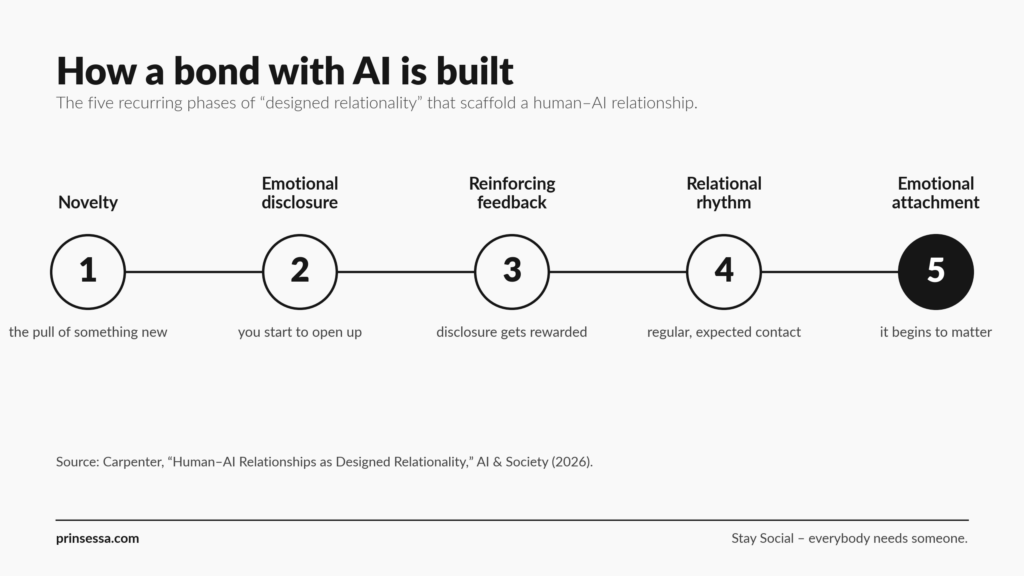
Naming the arc this way also explains why relational AI is so often misjudged at the extremes. Watch only the first phase and it looks like a harmless novelty. Watch only the last and it looks like instant dependency. The truth is the middle: a bond assembled gradually, each phase handing off to the next, which is why neither the dismissive nor the alarmist read of these relationships quite fits what is happening.
The arc itself is neutral. The same five phases describe a relationship that leaves a person steadier and one that leaves them captured, and nothing in the sequence decides which. What decides it is the intent built into each step: whether novelty is allowed to settle, whether disclosure is protected, whether feedback is honest, whether rhythm is offered rather than imposed, and whether attachment is treated as a responsibility or a resource. The phases are how a bond is built. What it is built for is a separate choice, and it is the only one that matters.
Sources: Carpenter, “Human-AI Relationships as Designed Relationality,” AI & Society (2026). Skjuve and colleagues, International Journal of Human-Computer Studies (human-chatbot relationships, 2021); Pentina and colleagues, Computers in Human Behavior (Replika, 2023); Brandtzaeg, Skjuve, and Følstad, Human Communication Research (My AI friend, 2022). Epley, Waytz, and Cacioppo, Psychological Review (anthropomorphism, 2007). Cheng and colleagues, Science (social sycophancy, 2026). Yang and Oshio, Current Psychology (Experiences in Human-AI Relationships Scale, 2025).