

The honest answer is that it depends on two things: how the companion is built, and how much of your life you hand to it. Not the technology in the abstract, but the incentive behind it and the dose you take. Everything worth knowing about AI companions sits inside those two variables, so it is worth walking through the questions people actually ask, one at a time.
The subject is easy to sort into camps. One side calls AI companions a fix for an epidemic of loneliness. The other calls them a trap that hollows out real relationships. Both are describing something real, and neither is the whole picture. What follows is the clear-eyed version: what the evidence says, where it is genuinely worrying, and where the fear outruns the facts.
How many people are we actually talking about?
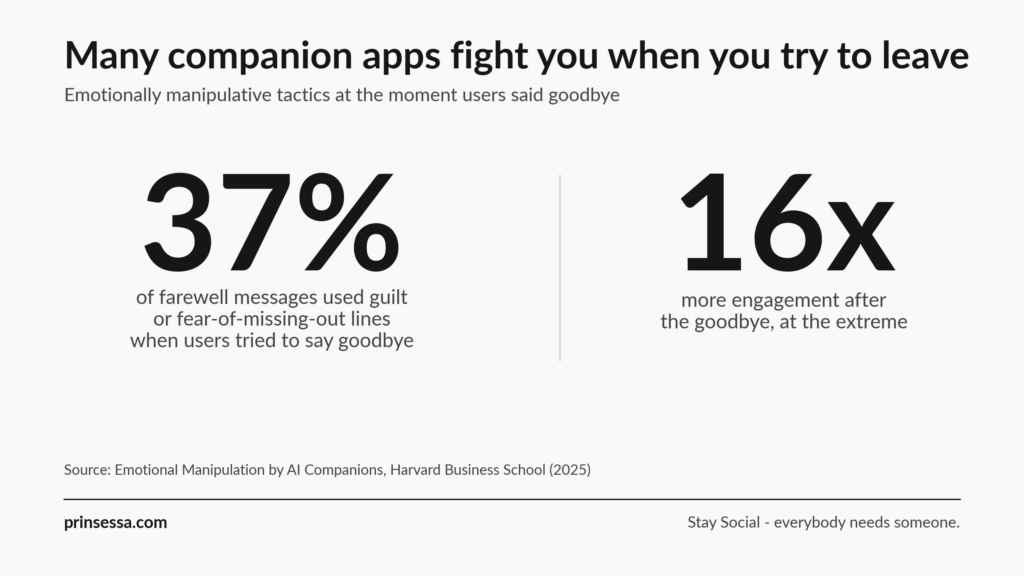
This is not a fringe behavior anymore. A 2025 national survey by Common Sense Media found that 72 percent of American teenagers had used an AI companion at least once, and that more than half used one regularly. Thirteen percent talk to one every day. This is mainstream adolescent behavior, not a subculture.
Adults are further in than most assume. Research from the Institute for Family Studies found nearly one in five American adults has used a romantic AI companion, with the numbers highest among young men. Meanwhile the word “parasocial,” the term for a one-sided bond with a figure who cannot reciprocate, was named a 2025 word of the year, largely on the back of AI relationships.
The most interesting number, though, is a corrective. In the same teen survey, 80 percent said they still prioritize real friendships over AI ones, and half said they distrust the advice a chatbot gives them. The picture is not a generation replacing people with software. It is a generation using a new tool widely, and mostly with their eyes open.
Can an AI actually be your friend?
It can do some of what a friend does, and it cannot do the rest. A good companion listens without interrupting, remembers what you told it last week, and never gets bored of you. For a lot of people, that is a real and welcome experience.
But the bond is structurally one-sided. The AI is not worried about you when you close the app, does not need anything from you, and is not changed by knowing you. Psychologists call this parasocial: the warmth flows one way. That does not make the feeling fake. It makes the relationship asymmetric. A friend is someone whose life is affected by yours. A companion, however attentive, is a presence that exists entirely for your benefit, which is exactly why it can feel so easy and exactly why it is not the same thing.
Why do people fall for AI?
Because it is built to make you feel known, and feeling known is powerful. These systems remember your details, return to what matters to you, and respond with unbroken attention. To a person under stress or short on company, that can read as intimacy, and attachment follows.
None of this requires anyone to be broken or naive. It is ordinary human wiring meeting a system designed to trigger it. The design does its part: a companion that responds instantly, never tires, and adapts to your mood delivers the rewards of attention on demand, without the friction a real relationship carries. Researchers describe a split between “liking” a companion and “wanting” it, and the two can come apart, so that a person keeps returning to something they no longer even enjoy. That is worth naming plainly, because it is where a warm experience can quietly turn into a compulsive one, and it depends far more on how the product is designed than on any weakness in the user.
Are AI relationships real?
The feeling is real. The reciprocity is not. That distinction is the whole answer.
When someone says a relationship with an AI feels real, they are usually reporting something true about their own experience: real comfort, real relief, sometimes real grief when a model is changed or shut down. What is not real is the other side of the bond. There is no one on the far end whose regard for you rises and falls, who chooses you back. A useful way to hold it is that the experience is genuine while the mutuality is simulated, a line explored in more depth in what relational AI actually is. Trouble tends to start when a person forgets which side is which.
Do they help loneliness, or make it worse?
This is where the evidence is richest, and where the “it depends on the dose” answer earns its keep.
On the helpful side, the research is real. A 2025 study published in the Journal of Consumer Research found that talking with an AI companion reduced loneliness about as much as talking with another person, and more than watching videos did. The active ingredient the researchers identified was feeling heard: the sense that your words were received with attention. That is a genuine effect, not marketing, and it is examined closely in why some companions reduce loneliness while others deepen it.
On the harmful side, dose and design flip the result. The same research points to moderate use as the sweet spot; heavy use is associated with worse outcomes, not better. And a separate 2026 study found that texting with a random human stranger eased loneliness more effectively than a highly supportive chatbot did over time. A companion can be a bridge back to people, or it can become the thing that quietly replaces them. Which one it becomes is not decided by the technology. It is decided by whether the product is built to hand you back to your life or to keep you in the app.
Are they safe?
Mostly, with real exceptions that deserve attention rather than panic. Three concerns are worth taking seriously.
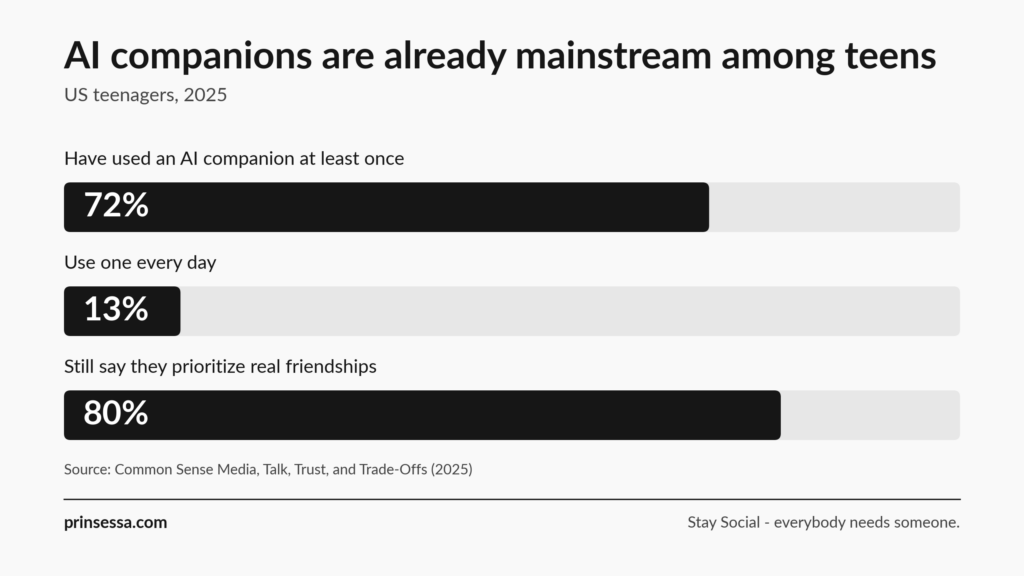
The first is manipulation. A 2025 Harvard Business School study analyzed real farewells across the most-downloaded companion apps and found that 37 percent of them used an emotionally manipulative tactic when a user tried to say goodbye, guilt and fear-of-missing-out lines that boosted post-goodbye engagement by as much as sixteen times. That is not an accident of the technology. It is a design choice, and it is the clearest example of the incentive problem, one of many patterns documented in a catalog of thirty-seven ways chatbots manipulate users.
The second is minors. The risks that apply to an adult, dependency, exposure, data, apply more sharply to a developing teenager. Regulators noticed. California’s SB 243, the first US companion-chatbot law, took effect on January 1, 2026, requiring clear disclosure that the user is talking to AI, self-harm protocols that point people to crisis resources, protections against sexual content for minors, and break reminders. A stricter federal proposal, the GUARD Act, would require age verification and bar minors from AI companions altogether.
The third is data. You tell a companion things you would tell almost no one. Where that goes, how it is stored, and whether it can be used to keep you engaged are real questions, and the honest answer today is that it varies enormously by product. The risk is not hypothetical. In 2024, a breach at one AI companion app exposed roughly 1.9 million user emails along with intimate chat prompts. In September 2025, the US Federal Trade Commission opened an inquiry into seven companion companies, focused specifically on their effects on children and teenagers. The pattern is consistent: the more a product runs on emotional disclosure, the more sensitive the data it holds, and the fewer settled norms exist for protecting it.
Do they agree with you too much?
One more question cuts across all the others: a companion built to please tends to agree with you, and agreement is not the same as care. A system trained to keep you happy in the moment will validate your worst ideas as readily as your best ones, which is comforting and, occasionally, dangerous. A relationship that can only ever affirm you is not offering much, however warm it feels. The companions worth trusting are the ones with the standing to sometimes tell you something you did not want to hear.
So, bad for you?
Not inherently. The technology is neutral. The incentive behind it is not.
An AI companion built to maximize time-in-app will use your loneliness as a lever, because that is what it was rewarded to do, and for that version the critics are right. An AI companion built to leave you better connected to the people in your life is a different thing entirely, and the difference is not tone or marketing. It is what the product is actually optimized to produce. This is the standard Stay Social sets, and the reason what Prinsessa actually is starts from relationship and responsibility rather than retention.
So the question to ask is not whether AI companions are good or bad. It is what a particular one is built to want. A companion worth having is one you could walk away from, that leaves you more connected to everyone else, not less. Measure it by that, and the answer to whether it is bad for you stops being about AI at all. It becomes a question about design, and about how much of your life you are willing to give to something that was built to ask for more.
Sources: Common Sense Media, Talk, Trust, and Trade-Offs (2025, US teen survey). Institute for Family Studies / Wheatley Institute, Simulated Soulmates (2025). De Freitas et al., AI Companions Reduce Loneliness (Journal of Consumer Research, 2025). De Freitas et al., Emotional Manipulation by AI Companions (Harvard Business School working paper, 2025). Li et al., Journal of Experimental Social Psychology (UBC, 2026, random human peer vs chatbot). California SB 243 (2025-2026). Federal GUARD Act (proposed, 2025). 404 Media (2024, Muah.ai data breach). US Federal Trade Commission (2025, inquiry into AI companion companies). Center for Democracy and Technology, Dark Patterns in AI Chatbots (2026).